
Is CBD Halal? What Muslims in the UK Should Know (2026 Guide)
This guide will help you ask the right questions and read labels with confidence in a UK context. It is educational, not a religious ruling. If you want a definitive answer for your personal situation, it is always best to check with a trusted local scholar or halal authority.
What CBD is (and why “is CBD halal?” is not one simple answer)
CBD stands for cannabidiol. It is a non-intoxicating cannabinoid from the hemp plant. On its own, CBD does not produce a “high” in the way that THC (tetrahydrocannabinol) can.
But “CBD” is also used as shorthand for lots of different products. A CBD oil might be full spectrum (CBD plus other naturally occurring plant compounds), broad spectrum (similar but with THC removed), or isolate (CBD only). A CBD drink might include flavourings, sweeteners, preservatives, or emulsifiers. A gummy might use gelatine or alcohol-based flavour extracts.
So from a practical standpoint, asking “is CBD halal?” usually means: “Is this specific CBD product halal, based on how it is made and what is inside it?”
If you want a broader foundation first, it can help to read our parent guide on premium CBD oil so you understand the basics of what you are actually buying.
The main halal considerations that come up with CBD
Islamic dietary guidance is bigger than a list of ingredients. It is also about intention, avoiding intoxication, and avoiding harm.
Consider this. Two products can both be labelled “CBD”, but one contains animal-derived gelatine and the other is vegan. One uses an alcohol-based tincture as the final product and the other uses a carrier oil. One contains trace THC and the other is THC-free. These differences can change how a scholar may view permissibility.
1) Intoxication (sukr) and “getting high”
CBD itself is generally classed as non-intoxicating. Concerns tend to focus on THC content, because THC is the compound associated with intoxication.
2) Harm (darar) and personal context
The reality is that “harm” is individual. If you have a health condition, take medication, or are pregnant or breastfeeding, you should speak to a GP or pharmacist before using CBD. This is sensible health practice, and it also supports the wider principle of taking care with what you put in your body.
3) Ingredients and processing
Halal questions often come down to ingredients (animal derivatives, alcohol, questionable additives) and processing (how the extract is produced, whether alcohol remains in the finished product, and cross-contamination risk in manufacturing).
THC, full spectrum CBD, and the “trace amount” question
This is usually the sticking point.
Full spectrum CBD contains CBD plus minor cannabinoids, terpenes, and other plant compounds, including trace THC within legal limits. Many people choose full spectrum because of the “entourage effect” idea, meaning the plant compounds may work better together than in isolation. That said, halal permissibility is not the same as “more effective”. It is about whether the presence of THC is acceptable.
Now, when it comes to UK law, CBD products must meet strict requirements around THC. Legal compliance matters, but it is not the same as halal certification or a fiqh ruling. If you want the UK legal angle in plain English, see Is CBD Oil Legal in the UK?.
Is trace THC automatically haram?
Different scholars and schools may approach this differently, especially when the amount is tiny, not intoxicating, and not used for intoxication. Some people feel comfortable with trace THC if it is unavoidable and does not cause intoxication. Others prefer to avoid it completely to remove doubt.
Think of it this way. If you know you will worry every time you take it, even a technically permissible option may not feel right for your routine. In that case, many people choose a THC-free (often isolate-based) product for clarity.
What about “is CBD halal Hanafi?”
People often ask this specifically because the Hanafi school can be cautious around intoxicants and alcohol-related issues. You will still find variation in opinion because scholars weigh the evidence differently, especially on modern extracts and trace compounds. The safest practical approach, if you follow a stricter view, is to look for products that are THC-free, alcohol-free in the finished product, and have transparent lab reports and ingredient lists.
Alcohol and CBD: extraction vs alcohol as an ingredient
Alcohol can show up in CBD in two main ways, and they are not the same thing.
Alcohol used during extraction
Some hemp extracts are produced using ethanol as a solvent. In many manufacturing processes, the ethanol is removed afterwards. Whether any residual alcohol remains, and whether that matters from a halal perspective, is a point people often raise with scholars.
What many people overlook is that the label does not always tell you the extraction method. That is why third-party lab testing and manufacturer transparency are so important.
Alcohol as a carrier or flavour ingredient
Some CBD tinctures (especially in the US) use alcohol as the base liquid. Some CBD drinks use flavourings that are dissolved in alcohol. Some gummies use flavour extracts that may have alcohol as a solvent.
If you want to avoid alcohol completely, look for “alcohol-free” wording, and then still check the ingredients list for terms like ethanol, alcohol, tincture, or “flavouring” with no further detail.
CBD oils, drinks, gummies, and patches: halal considerations by format
Your choice of format changes what you need to check.
CBD oil (drops)
CBD oils are often just hemp extract plus a carrier oil such as hempseed oil or MCT. That can be relatively simple from an ingredients standpoint, but the halal question may come back to whether it is full spectrum (trace THC) and how it was extracted.
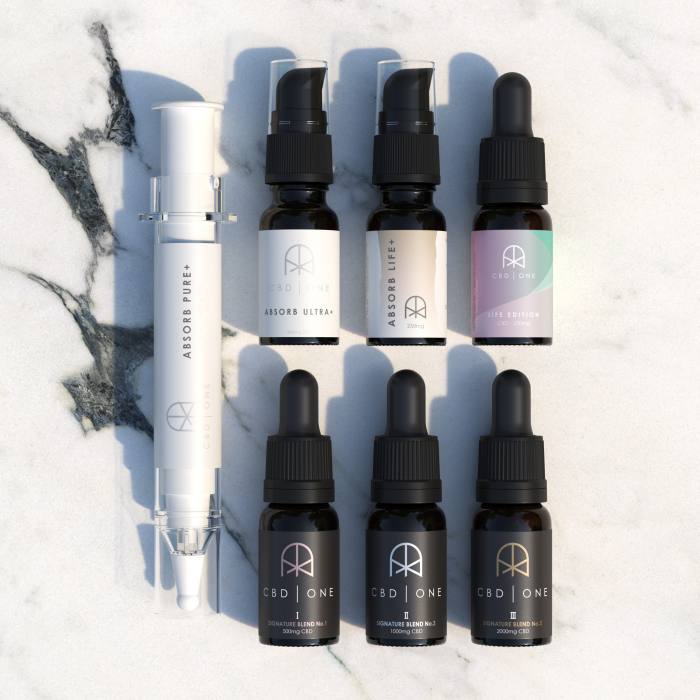
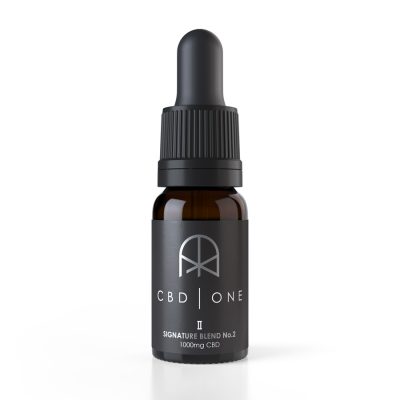
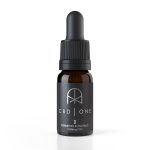
On CBD One, for example, the oils in our CBD Oils range are full spectrum, vegan, and plant-based. Some customers love full spectrum for the entourage effect philosophy. Others prefer THC-free options for faith, work, or sport reasons. Both approaches are valid, it depends on your priorities.
CBD drinks (including “trip CBD drink halal” type questions)
When people ask “is CBD drink halal?” they are usually asking about the added ingredients. Drinks can contain flavourings, preservatives, colourings, and sometimes functional botanicals. You also need to consider whether the drink contains caffeine or other stimulants if you are sensitive.
If you are unsure about beverages generally, it can help to understand how drink formulations work by reading Do CBD Drinks Work?. It does not answer halal directly, but it will help you spot what is actually in the bottle and why.
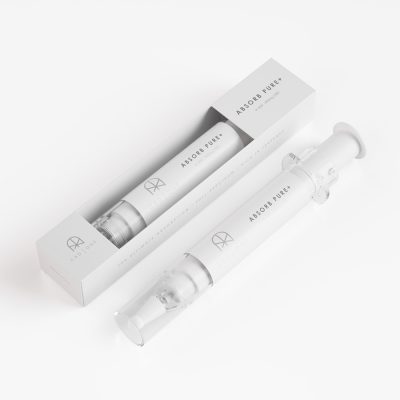
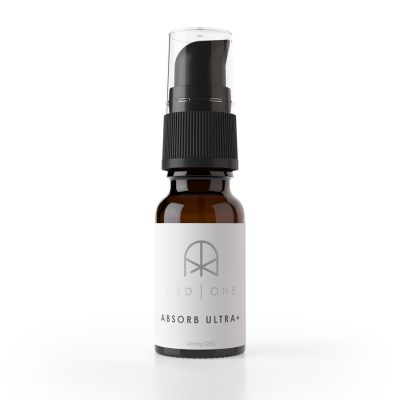
At CBD One, our water-soluble products are designed to be mixed into hot or cold drinks (for example, Absorb Ultra+ is a full spectrum, lab-verified, water-soluble format). From a halal perspective, you would still check the spectrum type, and you would also check for alcohol-based flavourings or unnecessary additives.
CBD gummies
The big red flags with gummies are often gelatine (animal source and whether it is halal-certified), flavourings (potential alcohol carriers), and colourings. Even if the CBD itself is fine, the gummy base might not be.
CBD One deliberately does not sell gummies. One reason is that gummy formulations can make transparency harder for consumers, especially around sugar, flavouring systems, and consistency of dosing.
CBD patches
Patches can be a practical choice if you want a measured dose without ingesting oils, flavourings, or sweeteners. You still want transparency on ingredients and THC content.
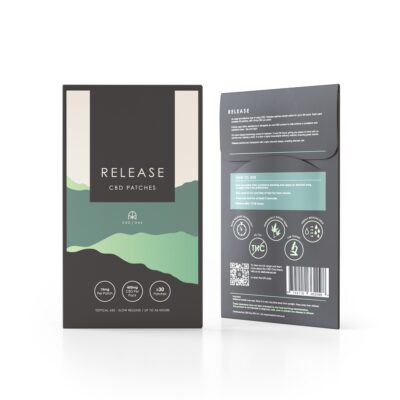
For example, CBD One’s CBD Patches [30 x 15mg] | Release use CBD isolate and are labelled THC-free, which some people prefer for extra peace of mind. As always, you would still check the full ingredients list and any available lab verification.
How to check if a CBD product is halal-friendly in the UK
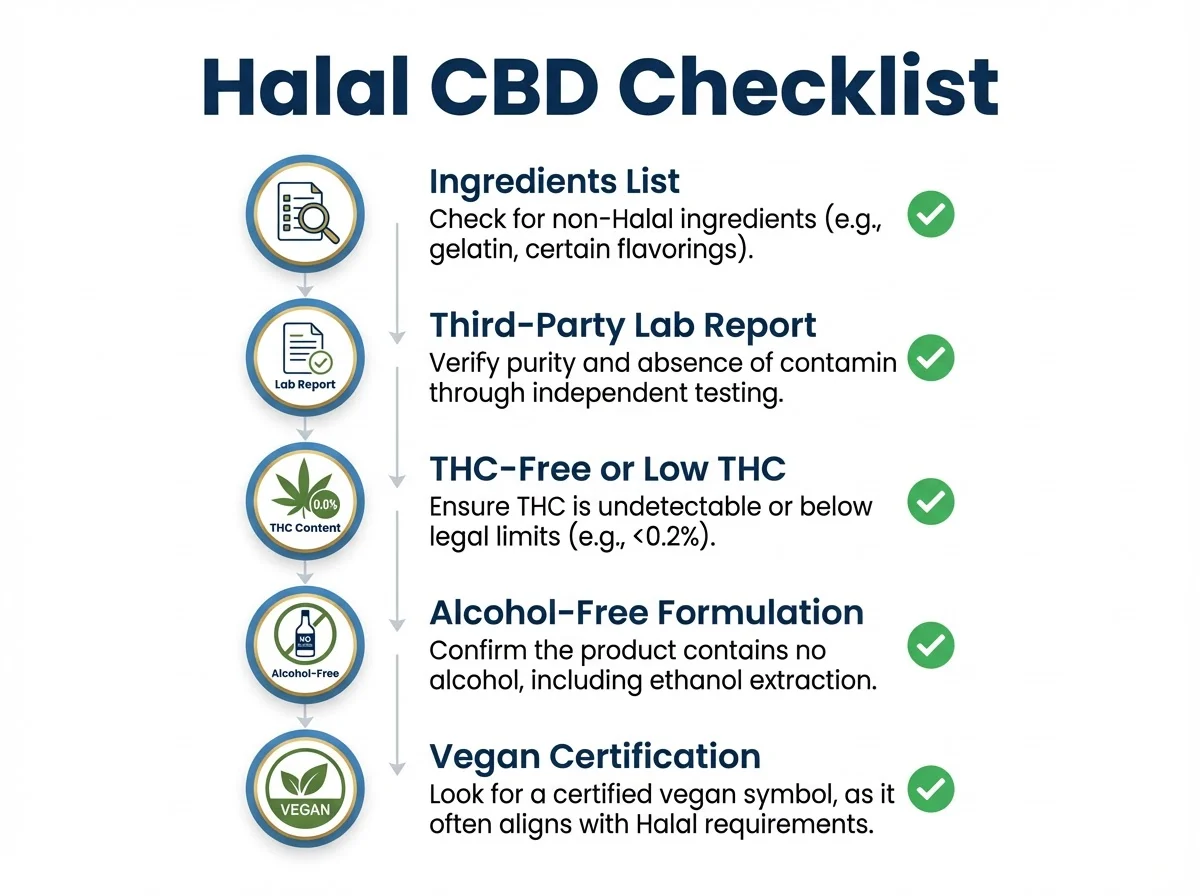
You do not need to be a chemist to make a good decision. You just need a simple method.
Start with the ingredient list
Look for obvious non-halal ingredients such as gelatine (unless clearly halal-certified), carmine, or unspecified “flavourings” that could be alcohol-based. Also check whether the product is labelled vegan if that matters for you.
Then check the type of CBD extract
Full spectrum means trace THC may be present. Broad spectrum usually aims to remove THC (but you still want proof). Isolate is CBD-only and typically THC-free. If you want to compare formats, strengths, and “what’s best for me?”, our CBD product comparison can help you weigh options without guesswork.
Look for third-party lab reports (COAs)
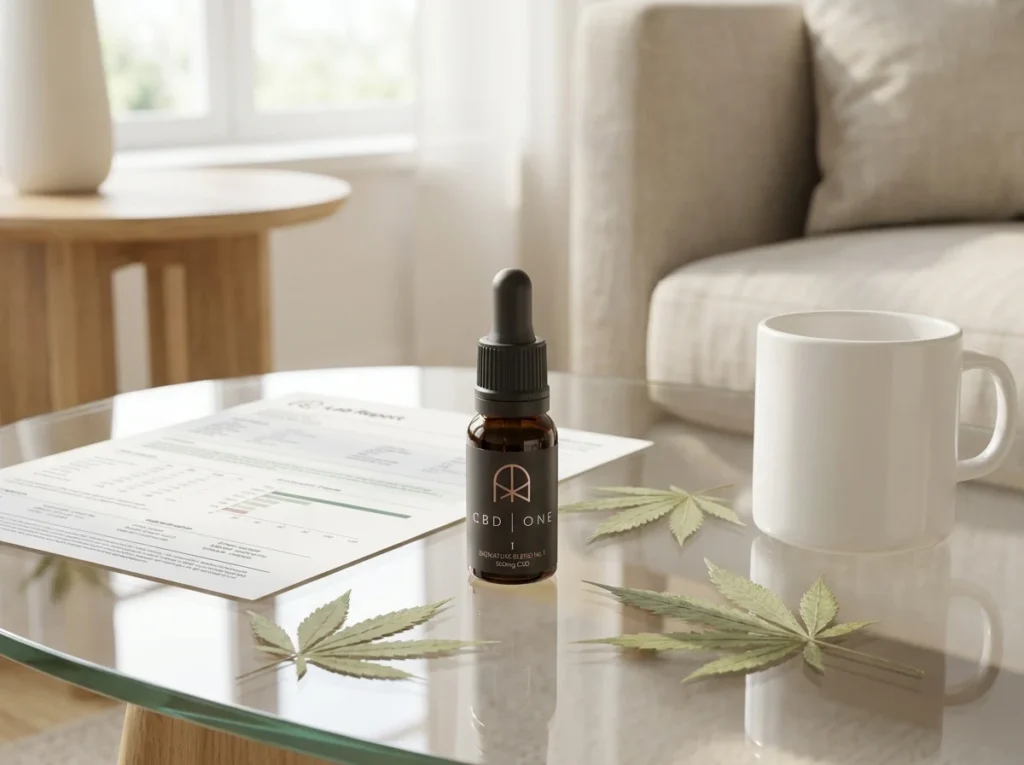
A certificate of analysis (COA) can show cannabinoid content, including THC levels, and sometimes contaminants testing. In an ideal world, you can match the COA to the batch number on your product.
If a brand cannot or will not share lab results, that is usually a sign to move on.
Check the “alcohol” question properly
Brands sometimes say “no alcohol added”, which is not the same as “alcohol-free”. If avoiding alcohol is important for you, ask directly: was ethanol used in extraction, and is any residual ethanol present in the final product?
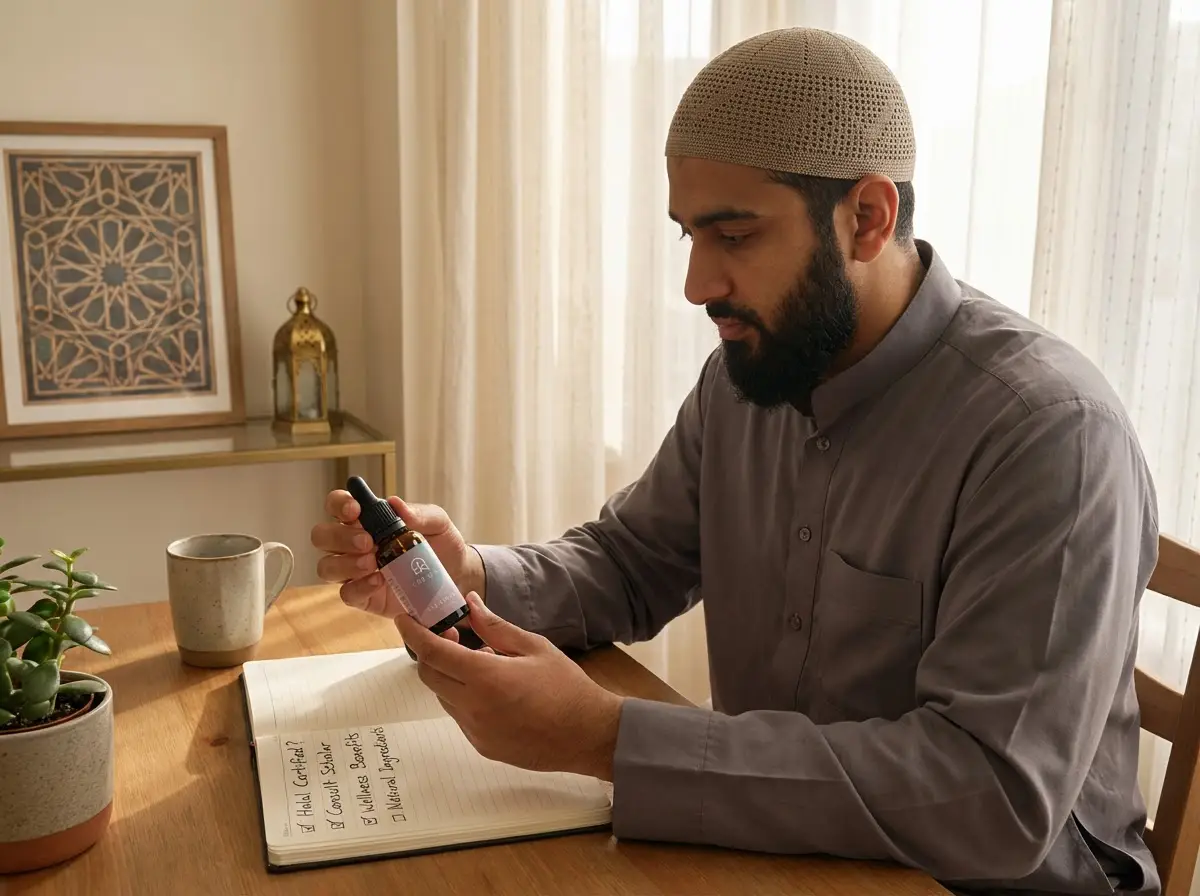
A practical halal checklist before you buy CBD
If you want something you can actually use when shopping, this is it.
- Is it intoxicating? CBD should not be. Check THC content and the spectrum type.
- Is it alcohol-free in the finished product? Look for clarity on ethanol, tinctures, and flavour carriers.
- Are there animal-derived ingredients? Watch gelatine in gummies and capsules, and check for vegan status if you prefer.
- Is there a recent third-party lab report? Ideally batch-specific, showing CBD and THC levels.
- Do you trust the company’s transparency? Clear answers beat vague marketing every time.
In practice, this means you can narrow choices quickly. If you want help on the non-religious side of choosing a product that fits your routine, the CBD buying guide is a good next read.
And if you are working out a sensible amount, remember the UK Food Standards Agency advises healthy adults not to exceed 70mg of CBD per day. A tool like our CBD dosage guide can help you translate “mg” into real-world servings, but always start low and go slow.
Halal certification: what it does (and does not) tell you
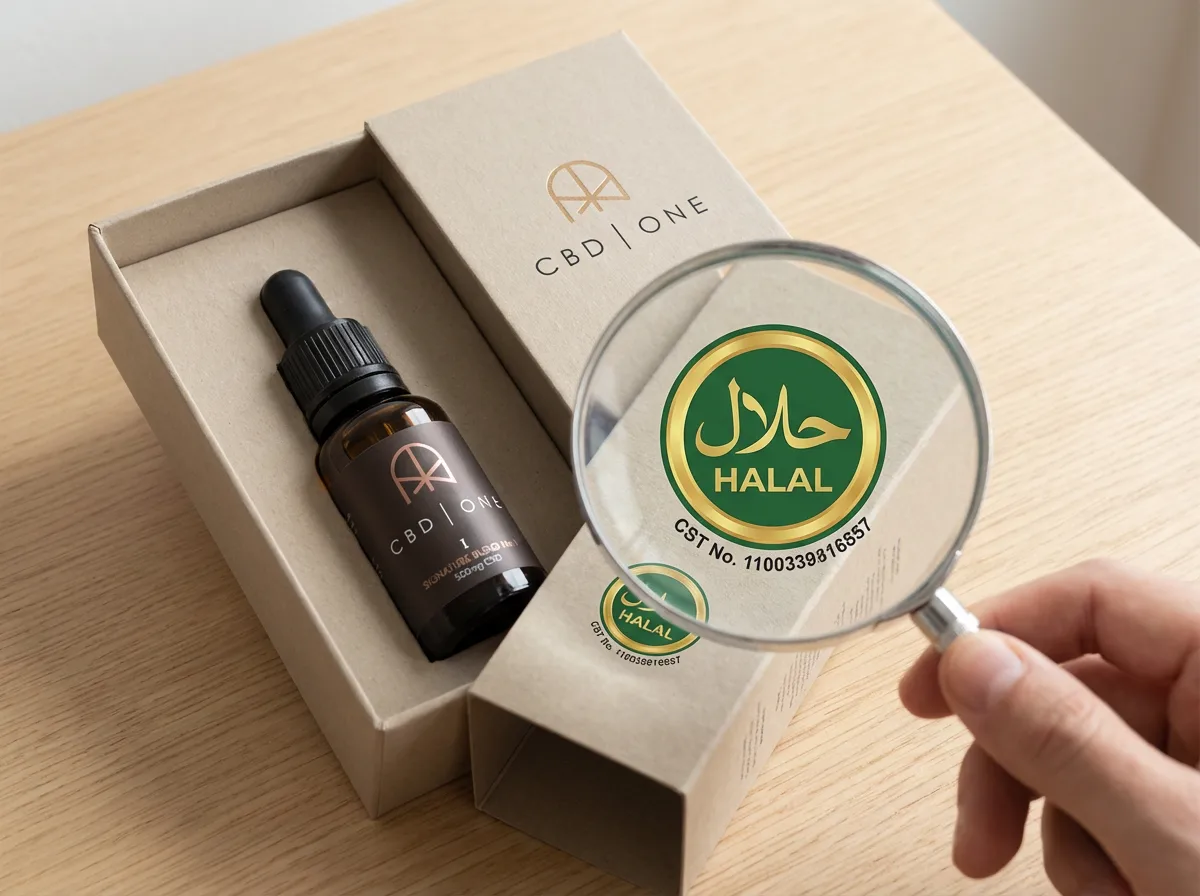
One gap I often see in the halal conversation is this: people assume “halal” is a yes or no label, when in reality certification is a process.
A halal certificate, when it exists, usually relates to a specific product, made in a specific way, with a specific ingredient supply chain. That can be reassuring, especially for capsules, gummies, or drinks where ingredients are more complex.
Here’s the thing. Not all CBD brands pursue halal certification, even if their products are vegan and alcohol-free in the finished form. Sometimes it is cost, sometimes it is manufacturing complexity, and sometimes it is that CBD itself is still new territory for some certifiers.
So if you do not see a halal logo, it does not automatically mean “haram”. It just means you need to fall back on the practical method in this guide: ingredients, spectrum type, THC, alcohol in the finished product, and a COA you can actually verify.
Vapes and smoking: where halal questions often come up
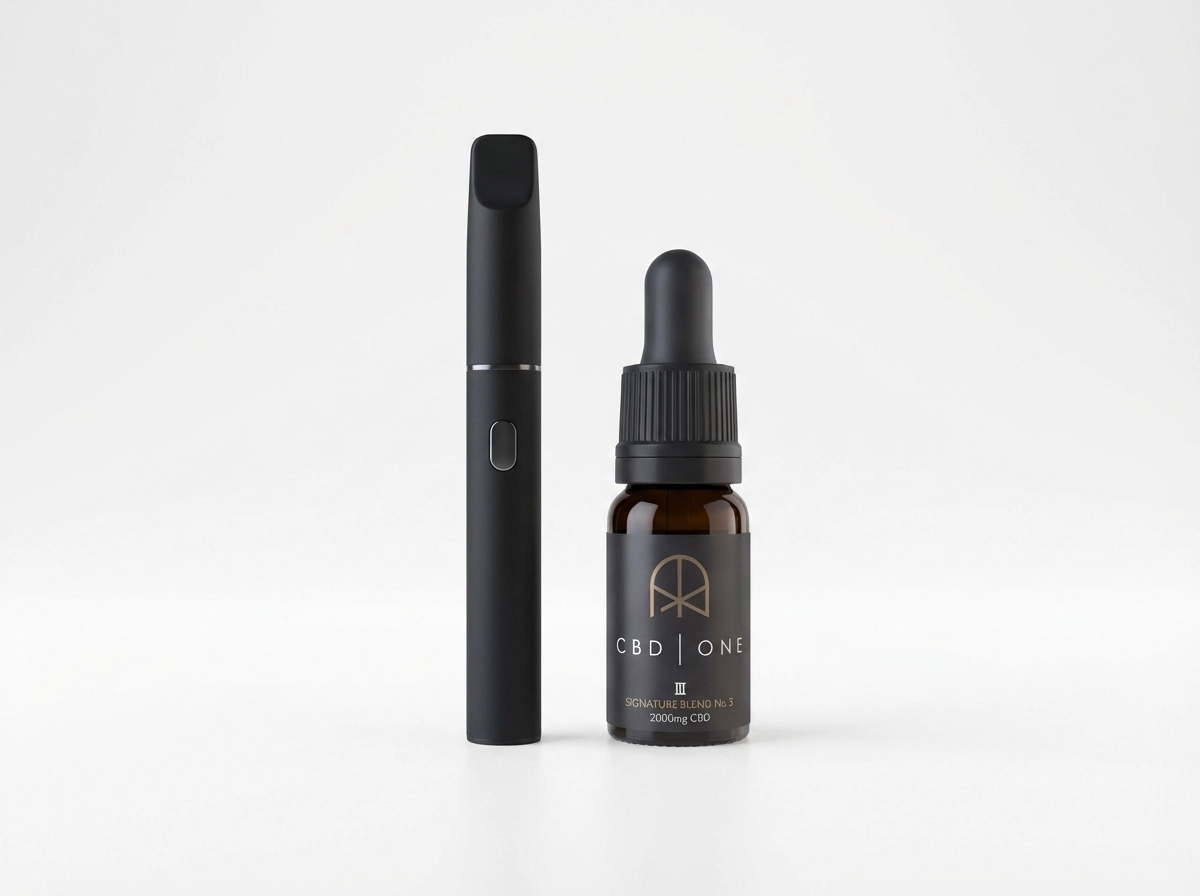
People regularly ask about vaping because it is common in the wider CBD market. It also tends to raise a different set of halal questions, not just ingredients.
From a purely practical standpoint, vape products can be harder to assess: ingredient lists are short, but they can include flavour systems and thinning agents, and it is not always clear what is used as a carrier. You still have the same core checks: THC content, alcohol-based flavourings, and lab verification.
What many people overlook is that vaping and smoking are also sometimes viewed through a wider lens of health and habit. If your aim is a simple, low-fuss routine that you feel comfortable with, many people stick to oils, patches, or water-soluble CBD mixed into a drink they already trust.
Capsules look simple on the outside, but they are one of the formats where halal issues can be hidden.
Hard capsules are often made from either gelatine or plant-based cellulose. Softgels are commonly gelatine-based, and the gelatine source is not always clearly labelled on the front of the pack.
Also keep an eye on the “small print” ingredients: humectants like glycerol (sometimes listed as glycerine), flavourings, and coatings. None of these are automatically non-halal, but vague sourcing is where doubt creeps in.
If capsules are your preferred format, look for a clear statement on whether the capsule shell is gelatine-free or suitable for vegans, and pair that with a COA that confirms the THC status.
Cross-contamination and manufacturing: why facility standards matter
Most people focus on the bottle or the ingredient list, but manufacturing matters too.
Consider this. A product can have a clean ingredient list, but if it is produced in a facility that also handles non-halal ingredients, you may want to know what controls are in place. The same goes for THC management. If a facility manufactures multiple spectrum types, good batch control and cleaning processes help reduce the risk of mix-ups.
You will not always get these answers from a label, but you can look for signs of maturity as a brand: clear batch numbering, accessible lab reports, and straightforward customer support when you ask how products are made.
Travelling, work, and drug testing: the practical side of trace THC

Even if your main question is halal, it is worth thinking ahead to the practical side of trace THC, especially with full spectrum products.
Some workplaces and sports organisations use drug testing that looks for THC metabolites. A legal, compliant CBD product is designed to keep THC within legal limits, but “legal” does not always mean “zero”, and drug testing policies can be stricter than UK retail rules.
If you travel, it is also worth remembering that CBD rules vary by country, and what is acceptable in the UK may not be treated the same elsewhere. If you want the simplest path for travel or workplace peace of mind, many people choose THC-free products with lab verification showing no detectable THC.
Frequently Asked Questions
Is CBD halal in Islam?
CBD itself is a non-intoxicating compound from hemp, so many people view it differently from intoxicants. But whether a CBD product is halal often depends on the details: THC content (even trace), whether alcohol is present in the finished product, and whether any non-halal ingredients were used (like gelatine in gummies). Because there are differences of opinion, the most helpful approach is to choose a product with transparent ingredients and lab reports, then ask a trusted scholar if you want a personal ruling.
Is CBD oil halal in the UK?
Some CBD oils may be halal-friendly, but you have to check what kind of extract it uses and what else is in the bottle. Many UK oils are made with hemp extract and a carrier oil, which keeps ingredients simple. The bigger questions are whether the oil is full spectrum (meaning trace THC may be present) and whether the manufacturer can show third-party lab results. If you want the strictest route, you may prefer THC-free options and a clear statement that no alcohol is present in the finished oil.
Is CBD haram because it comes from cannabis?
It is understandable to feel cautious because cannabis is associated with intoxication. CBD is different from THC. CBD is non-intoxicating, and hemp-derived CBD products in the UK are designed not to make you feel “high”. That said, some CBD products contain trace THC (especially full spectrum), which is where concerns often come from. If your goal is to avoid any doubt, look for THC-free products (often CBD isolate) with lab verification showing no detectable THC.
Is full spectrum CBD halal?
Full spectrum CBD contains multiple cannabinoids and terpenes from the hemp plant and can include trace THC within legal limits. Some Muslims are comfortable with this if the amount is tiny and non-intoxicating, and the intention is wellbeing rather than intoxication. Others prefer to avoid any THC at all. There is not one universal answer, so it becomes a personal decision informed by your school of thought and comfort level. If you want to avoid debate, choose THC-free products with clear lab reports.
Is CBD halal Hanafi?
Within the Hanafi school, people often take a more cautious approach to anything connected with intoxicants and alcohol. Because CBD products vary, you cannot give a blanket answer. If you follow a stricter interpretation, it is sensible to prioritise: THC-free (isolate-based) products, no alcohol in the finished product, transparent ingredient lists, and independent lab results. If you want certainty for your situation, bring the product label and COA to a trusted scholar and ask for guidance based on the exact formulation.
Are CBD drinks halal?
Some CBD drinks may be halal-friendly, but drinks tend to have longer ingredient lists. Check for alcohol-based flavourings, preservatives, and any “botanical extracts” with unclear carriers. Also check whether the CBD is full spectrum or THC-free. If a drink brand cannot show a lab report for cannabinoid content, that is a red flag. For many people, a simple water-soluble CBD added to your own drink at home feels easier to control, because you know exactly what else is in the glass.
Is Trip CBD drink halal?
I cannot confirm the halal status of any specific third-party brand because formulations can change and halal certification is a separate process. What you can do is check the product’s ingredient list, look for alcohol or alcohol-based flavourings, and confirm the CBD type (full spectrum vs isolate) and THC status. If the company provides a COA, review it for THC. If anything is unclear, contact the manufacturer and ask directly, then share that information with a trusted scholar if you want a definitive religious ruling.
Are CBD gummies halal?
Gummies are one of the trickiest CBD formats for halal compliance. The CBD itself may be fine, but the gummy base often contains gelatine, and unless it is explicitly halal-certified gelatine, that is a common issue. Flavourings can also be alcohol-based, and colourings can be questionable if not specified. If you want to keep things simple, choose formats with fewer ingredients, like oils, patches, or clearly labelled vegan products, and always look for lab testing for THC content.
Is CBD isolate halal?
CBD isolate is usually the simplest option from a “what exactly is in it?” perspective because it contains CBD only, with other cannabinoids (including THC) removed. Many people who want to avoid trace THC choose isolate-based products for peace of mind. You still need to check the rest of the formulation, including carrier oils, capsules, flavourings, and whether any alcohol is present in the final product. A third-party lab report remains important, because it confirms what the label claims.
Can I take CBD if I am on medication?
If you take prescription medication, speak to your GP or pharmacist before using CBD. CBD can interact with some medicines, and it is not worth guessing. This is especially important if you take medicines with a “grapefruit warning”, blood thinners, or anti-epileptic drugs. Start low, go slow, and keep your routine consistent so you can observe how you feel. If you want a deeper safety overview, our team always encourages cautious, informed use rather than experimenting without support.
Is CBD halal Shia?
Different scholars and communities can weigh the same product details differently, and it is not always helpful to assume one simple answer applies across the board. If you are Shia and want a decision you feel settled on, bring it back to specifics: is it intoxicating, is there THC (even trace), is there alcohol in the finished product, and are there any animal-derived or unclear ingredients. If you want certainty, share the ingredient list and COA with a trusted scholar you follow and ask based on that exact formulation.
Is CBD vape haram?
For many people, the question here is not only CBD, it is the combination of inhalation, ingredients, and intention. CBD itself is generally viewed as non-intoxicating, but vape products can sometimes be less transparent around flavour systems and carriers. If you are trying to avoid doubt, it is usually simpler to choose formats where the ingredient list and lab testing are easier to interpret, and to speak with a trusted scholar if you want a personal ruling.
Is CBD a drug?
In the UK, over-the-counter CBD products are typically sold as wellness supplements, not as medicines. They are intended to support general wellbeing rather than to act like a prescribed drug. That said, CBD is an active compound and it can interact with some medications, which is why it is sensible to be cautious, check lab reports, and speak to a GP or pharmacist if you are on prescription medicines.
Is CBD halal to drink?
CBD itself is not an intoxicant in the way alcohol is, but “CBD to drink” usually means a CBD beverage, and those can include a lot of extra ingredients. If you want a halal-friendly option, check the drink for alcohol-based flavourings, confirm whether the CBD is full spectrum or THC-free, and look for a COA that shows THC status. Many people find it simpler to add a water-soluble CBD to a drink they already know is suitable, because you control the ingredients.
Key Takeaways
- “Is CBD halal?” is usually product-specific: check THC, alcohol, and added ingredients.
- Full spectrum CBD may include trace THC, which is where many halal concerns focus.
- Gummies are often hardest to verify due to gelatine and flavouring systems.
- Look for third-party lab reports (COAs) and clear manufacturer answers on extraction and residual solvents.
- When in doubt, choose THC-free, alcohol-free products and ask a trusted scholar with the label and COA.
Conclusion
Most people asking “is CBD halal?” are not looking for a trend. They are looking for reassurance. And in my experience, reassurance comes from clarity: knowing the spectrum type (full spectrum, broad spectrum, isolate), understanding the THC question, checking for alcohol in the finished product, and scanning the ingredients for anything animal-derived or vague.
The reality is that there can be differences of scholarly opinion, especially around trace THC and extraction processes. That is why I always recommend taking a simple, evidence-led approach: choose brands that publish lab reports, ask direct questions, and keep your first choice as uncomplicated as possible.
If you are unsure what format fits your routine, explore our guides or speak to Nick for free, practical advice.