
Does CBD Show Up on Drug Test? (UK 2026 Guide)
In this guide, I will walk you through what UK drug tests typically screen for, why “THC-free” is not always as clear-cut as it sounds, and how to lower your chances of a surprise result. No scare tactics, just practical, honest education so you can make a confident decision.
What drug tests actually look for (CBD vs THC)
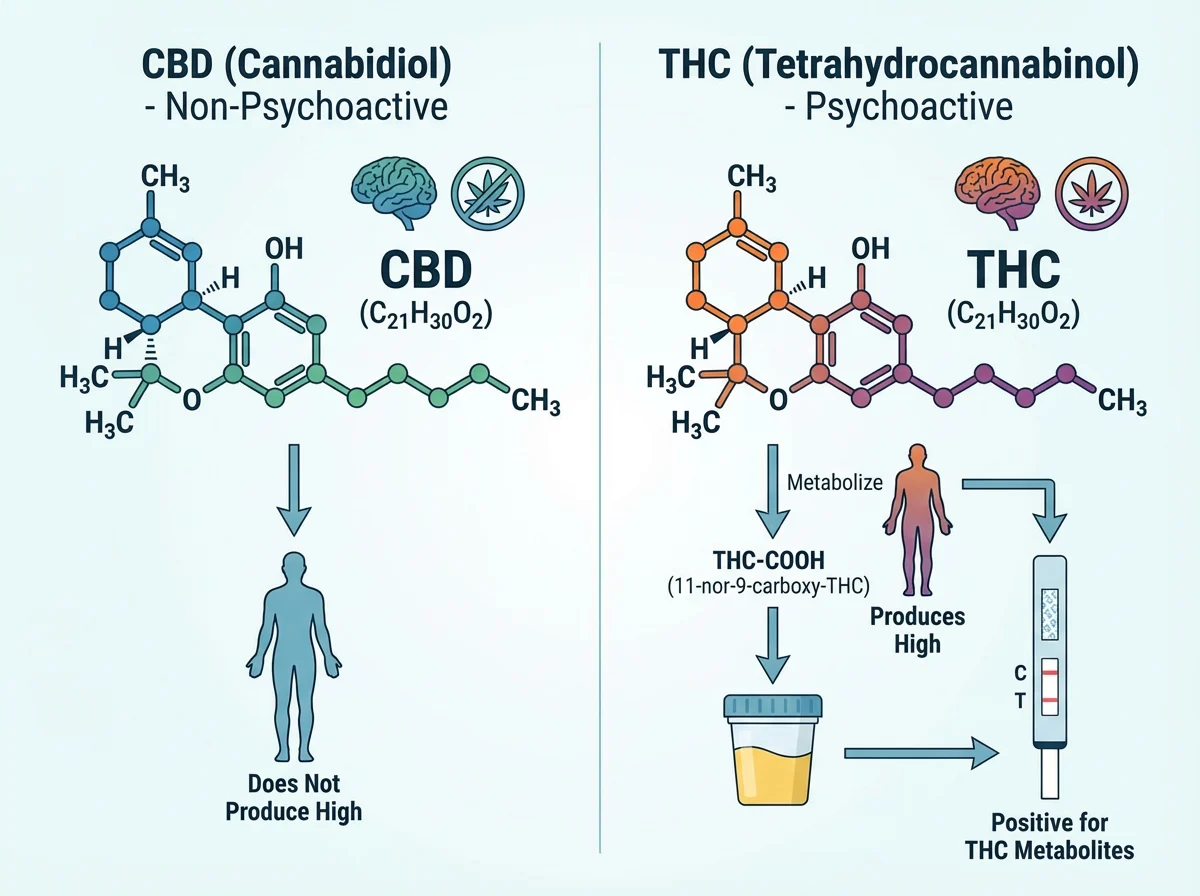
Most drug tests are designed to detect drugs of misuse, not wellness supplements. CBD (cannabidiol) is non-intoxicating and, by itself, is not what standard panels are screening for.
What they usually target is THC or, more commonly, THC-COOH, which is a metabolite your body produces after THC is broken down. Think of THC-COOH as a “fingerprint” that THC was in your system, even after the noticeable effects are long gone.
So if you are asking “does cbd show up on a drug test”, the more accurate question is: could the CBD product I am taking expose me to enough THC (even tiny amounts) to produce a positive result?
If you are newer to CBD and want a broader grounding first, it is worth reading our guide to premium CBD oil so you understand what is actually in different oils and extracts.
Common UK drug tests and detection windows
From a practical standpoint, the type of test matters just as much as what you take. Different tests look for different markers and have different time windows.
Urine tests (most common for workplaces)
Urine testing is the standard in many UK workplace policies. It usually detects THC metabolites rather than “active” THC. That means you can test positive even when you feel completely normal, depending on dose, frequency, metabolism, and the sensitivity (cut-off) used by the lab.
Saliva tests (often used roadside or for screening)
Saliva tests tend to look for more recent exposure and are more associated with “near-time” use. They can still be relevant for people who use cannabis, but CBD itself is not usually the target. If driving is part of your concern, read CBD Oil And Driving for a sensible UK-focused breakdown.
Blood tests (more specific, less common)
Blood tests are typically used in clinical or legal contexts rather than routine workplace screening. They can detect THC and sometimes metabolites, but they are not the most common scenario for everyday employment testing.
Hair tests (longer look-back window)
Hair testing can look back further, but it is less common and more expensive. It is usually reserved for specific roles or investigations rather than general employment screening.
The reality is: it is hard to give a one-size answer for how long “THC from CBD” might be detectable, because it depends on how much THC was present, how often you use the product, and your own physiology.
Why CBD can still trigger a positive test
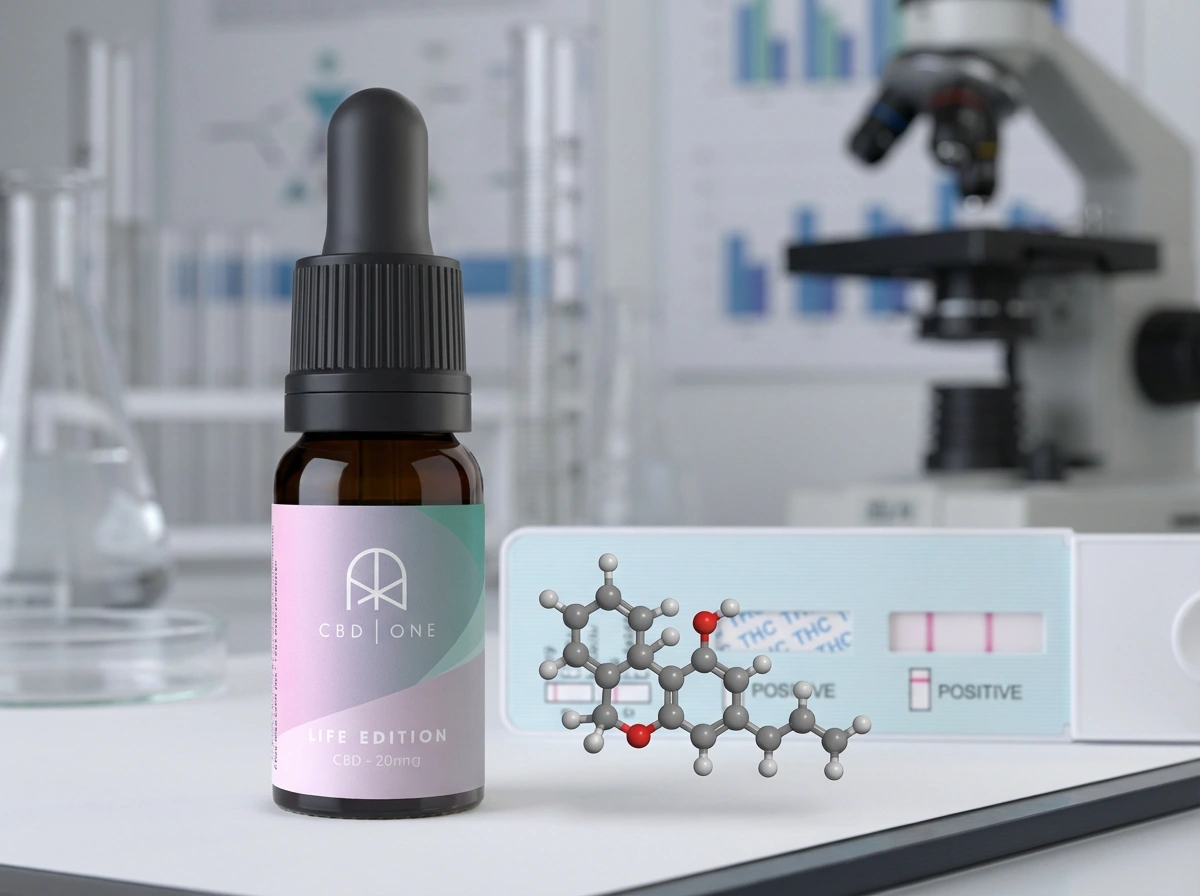
Consider this: even if CBD is not what the test is looking for, your product might still contain compounds that matter for testing.
1) Full spectrum products can contain trace THC
In the UK, legally sold CBD products must be compliant with UK rules, and reputable brands work hard to keep THC within legal limits. Still, “within legal limits” does not always mean “zero”.
If you are using full spectrum CBD daily, those trace amounts can add up in the body for some people. That does not mean you will definitely fail a test. It means the risk is not zero.
2) Labelling can be unclear or inaccurate
What many people overlook is that not all CBD products are created with the same standards. Some brands provide detailed batch testing (Certificates of Analysis), while others provide little more than marketing language.
Mislabelled products can contain more THC than expected. That is where most of the horror stories come from.
3) Cross-contamination and manufacturing quality
Even when a product is intended to be THC-free, cross-contamination can happen if manufacturing is not controlled properly. This is why third-party testing and good manufacturing standards matter so much when drug testing is a concern.
Full spectrum vs isolate: what matters for drug testing
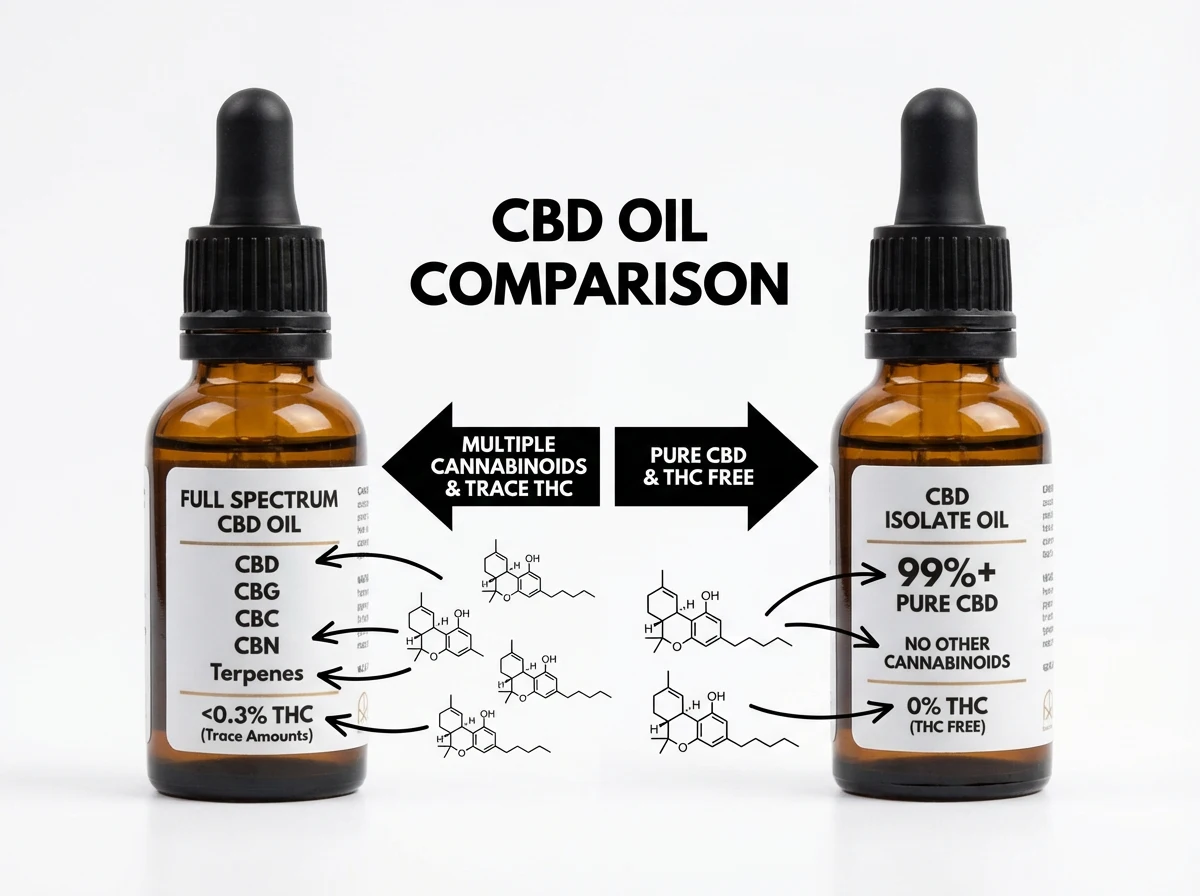
If your job or sport involves strict testing, choosing the right type of extract is often the biggest lever you can pull.
Full spectrum
Full spectrum products contain CBD plus other naturally occurring hemp compounds like minor cannabinoids and terpenes. Many people choose full spectrum because of the “Entourage Effect”, where multiple plant compounds may work together. The trade-off is that full spectrum can contain trace THC, which is the key drug-testing consideration.
CBD isolate
CBD isolate is CBD on its own, with other cannabinoids removed. In theory, this offers the lowest risk for THC-related positives because there should be no THC present. In practice, you still want proof through independent lab reports, because quality varies by brand.
Different formats can change your exposure
Now, when it comes to formats, your total cannabinoid exposure is mostly about the extract and the dose, not whether it is an oil, capsule, drink, or patch. But formats can influence how consistently you take it and how easy it is to measure.
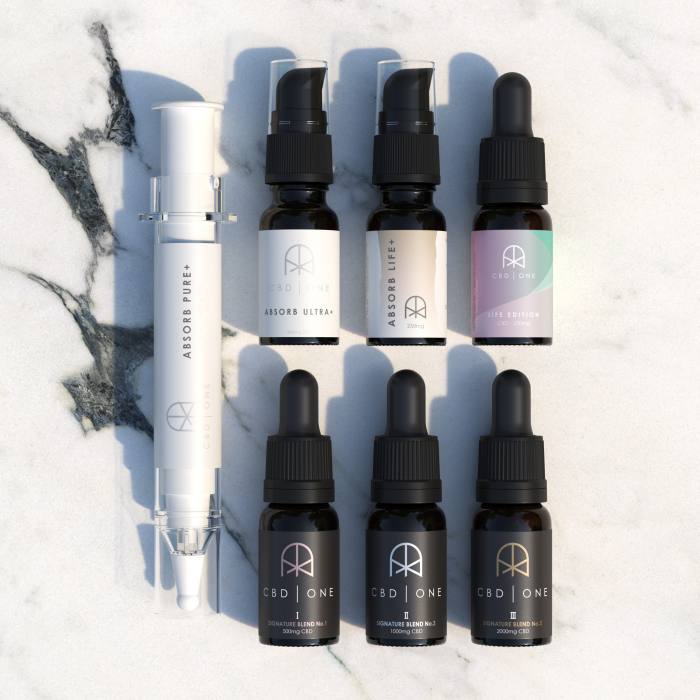
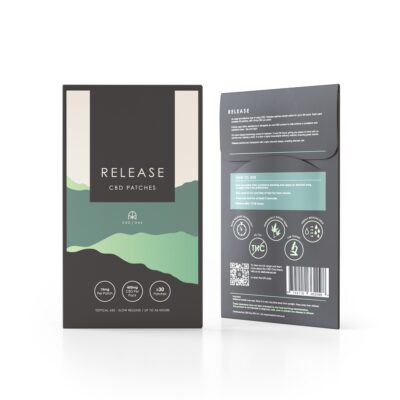
For example, CBD patches can offer a measured amount per patch. CBD One’s CBD Patches [30 x 15mg] | Release use CBD isolate and are labelled THC-free, which is one reason some tested professionals prefer isolate formats.
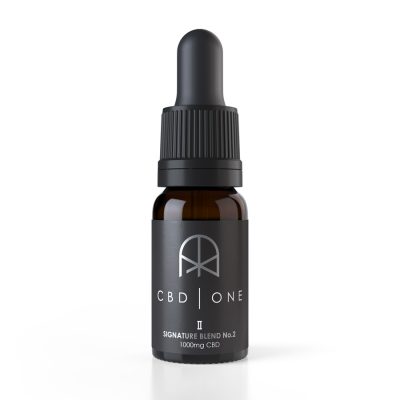
If you are more interested in oils and how they differ by strength and style, you can browse the CBD Oils category to understand what “full spectrum” usually means in practice.
Cut-offs, sensitivity, and why “a tiny amount” can still matter
Here’s the thing: two people can use the same bottle and have very different outcomes, partly because not all tests are run the same way.
Workplace testing often starts with a screening test. Screenings typically use a “cut-off”, which is basically a line in the sand. If your result is above it, it flags as positive and may be sent for confirmation. If it is below, it reports as negative.
That matters because trace THC exposure does not need to be huge to create uncertainty. If someone is using a full spectrum product daily, their body may have more opportunity to build up measurable THC metabolites over time, even when the product is legal and they feel perfectly normal.
It also helps to understand that screening tests are designed to be quick, not to explain exactly what happened. A confirmatory lab test is usually more specific. If your employer uses confirmation testing, that is often where the real clarity comes from.
What “THC-free” and “non-detectable” really mean on lab reports
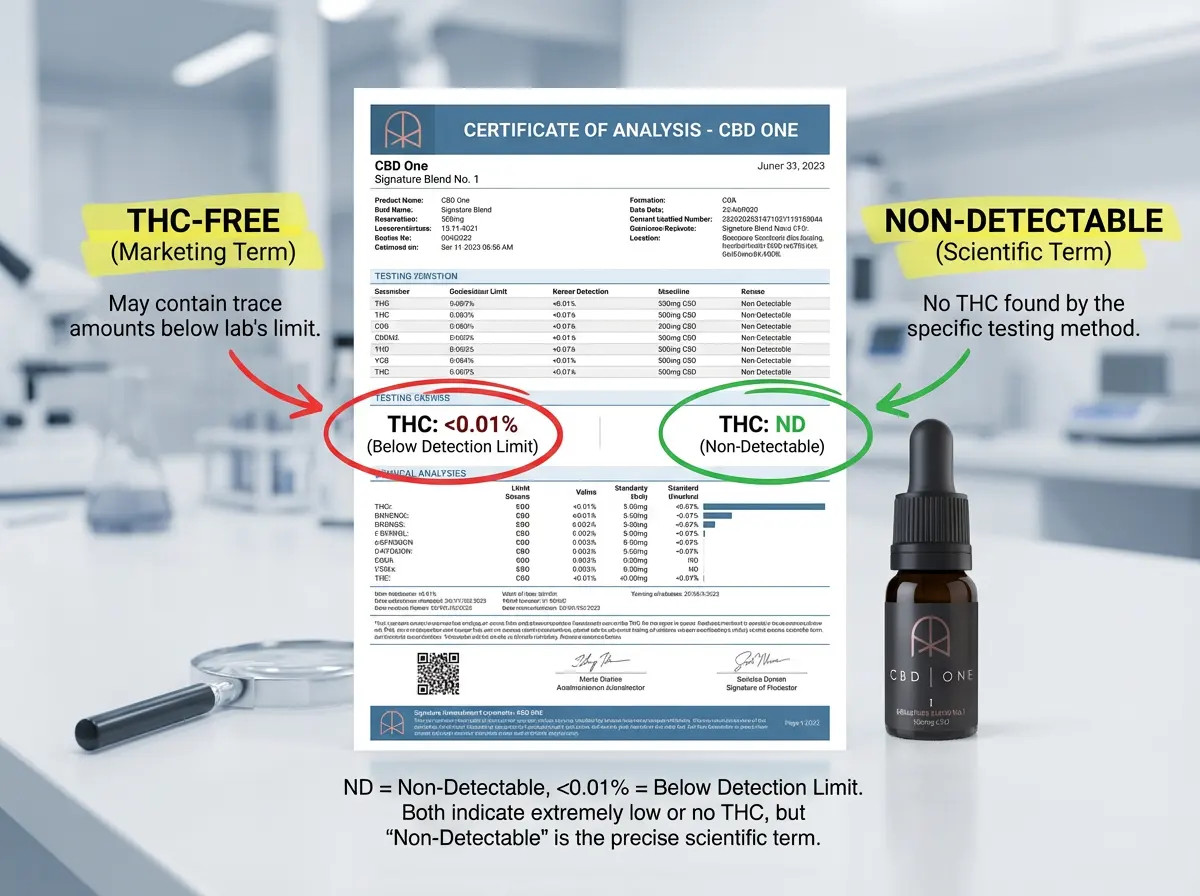
“THC-free” is one of those phrases that sounds simple, but can hide a lot of nuance.
On a proper Certificate of Analysis, you may see THC (and sometimes THCA) listed with a number, or listed as “ND”, meaning non-detectable. Non-detectable does not always mean the compound is absolutely not present. It usually means the lab method did not detect it above the limit of detection for that test.
From a practical standpoint, if you are drug tested, what you want is consistency and transparency. A batch-specific COA that clearly shows THC results, matched to the batch number on your product, gives you a much stronger footing than a generic “THC-free” claim on a label.
And if you ever feel confused reading a COA, you are not alone. The important part is not becoming an expert overnight. It is knowing what to look for: batch match, cannabinoid breakdown, and THC results that are clearly stated, not implied.
How to reduce your risk if you are tested
If you are in a tested role, your goal is simple: reduce THC exposure and reduce uncertainty.
Choose products with transparent, batch-specific testing
Look for a recent, third-party Certificate of Analysis (COA) for the batch you are buying, not a random report from years ago. You want to see cannabinoid breakdown, including THC, and ideally screening for contaminants.
Be realistic about “THC-free” language
Some labels say “THC-free” when they mean “non-detectable” under a certain lab method. That can still be helpful, but it is worth understanding the nuance. If your tolerance for risk is basically zero, you want the cleanest documentation you can get.
Keep your daily amount sensible
Even with good products, higher daily use can increase the chances of trace THC building up. The UK Food Standards Agency (FSA) advises healthy adults not to exceed 70mg of CBD per day. That guidance is about general safety, not drug testing, but it is still a useful guardrail for many people.
Stick to measured dosing and avoid “guesswork” products
Products that are hard to measure, or that encourage heavy use, can increase variability. If you want help working out a sensible personal starting point, our CBD dosage guide can help you think through body weight, routine, and goals in a more structured way.
Think through format and routine
Some people do better with oils, others with water soluble drops mixed into a morning drink, and some like patches for their simplicity. If you are exploring drink-mixed options, the Water Soluble CBD category is a useful educational reference point for why some products are formulated differently.
One small note about us, just for context. At CBD One we focus on full spectrum extracts across our core oil range because we value the whole-plant approach. If you are drug tested, you may prefer isolate-based formats for peace of mind, depending on your workplace policy.
What can influence your risk day-to-day
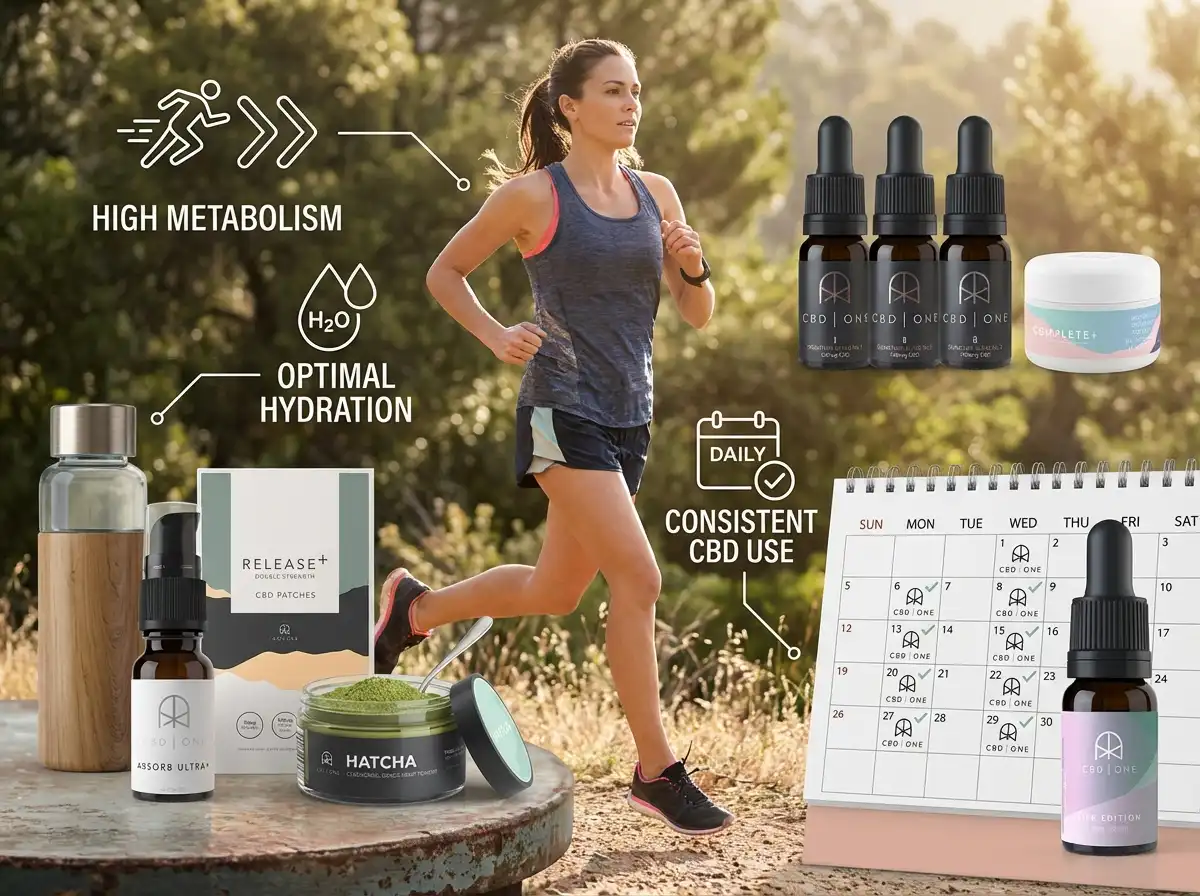
The question “will this show up on a drug test?” often gets treated like it has a yes or no answer. In real life, it is more like a set of dials that can turn risk up or down.
Some of those dials are in your control. Others are not.
Frequency and consistency
An occasional low serving is a different situation from daily use over weeks. If there is any THC in the product, repeated exposure gives your body more opportunity to produce detectable metabolites.
Your body and lifestyle factors
Metabolism, body fat, hydration, and general lifestyle can all influence what ends up in a urine sample. This is why two people can take something similar and see different results on a sensitive test.
Product type and the “unknowns”
Full spectrum can be higher risk for tested users because of the possibility of trace THC. Isolate should, in theory, lower that risk, but only if the product is genuinely clean and backed by batch testing.
What many people overlook is that the biggest risk is often not CBD itself, it is uncertainty. Vague lab reports, no batch number, unclear THC results, or a brand that cannot answer basic questions are all avoidable problems.
Trying to “flush your system”
People often ask about flushing, detox kits, or quick fixes. The reality is that these approaches can create more problems than they solve, especially if they interfere with hydration levels and trigger an invalid sample. If you are worried about an upcoming test, the safer and more professional route is to pause use, keep your routine normal, and speak to occupational health about your options.
What to do if you test positive after using CBD
First, try not to panic. False positives and administrative errors can happen, and screening tests are not always the final word.
Ask what test was used and whether confirmation testing is available
Many organisations use an initial screening test, then a more specific confirmatory test if the screen is positive. Confirmatory testing is better at distinguishing compounds and reducing false positives.
Document what you took
Keep the product packaging, batch number, and any lab reports you can access. If the product has a COA, save it. If you can show you used a regulated wellness product with transparent testing, that can be relevant context for an occupational health conversation.
Be careful with disclosure and seek professional advice
Workplace drug testing policies vary. If you are unsure how to handle the conversation, consider speaking to occupational health or a legal professional. If you take any medicines, it is also sensible to read CBD and Medication and to speak with your GP or pharmacist.
If you are still choosing products and want a neutral checklist of what to look for, our CBD Buying Guide and CBD Product Comparison can help you sort marketing from meaningful quality signals.
Frequently Asked Questions
Does CBD show up on a drug test in the UK?
CBD itself is not usually what workplace drug tests are designed to detect. Most panels screen for THC or THC metabolites. The risk with CBD comes from the possibility of trace THC in some products, especially full spectrum extracts, or from poor-quality products with inaccurate labelling. If you are tested at work, assume the test is effectively a THC test, then choose products and doses with that in mind. When in doubt, ask your employer what substances they screen for and what cut-offs they use.
Does CBD oil show up on a drug test UK employers use?
Standard employer urine tests typically do not test for CBD. They focus on THC metabolites. A CBD oil could still be linked to a positive result if it contains THC (even trace amounts) and if your usage pattern leads to enough exposure for metabolites to cross the lab’s threshold. Frequency matters here. Occasional low use may carry less risk than daily high use, but there is no promise either way. If testing is strict, consider an isolate product with strong third-party testing.
Will a “THC-free” CBD product guarantee I pass a drug test?
No brand can honestly guarantee you will pass a drug test. “THC-free” can mean different things, and it depends on the quality controls, the lab method used, and how your workplace test is performed. What you can do is reduce risk: choose products with recent, batch-specific third-party lab reports that show non-detectable THC, stick to measured dosing, and avoid products with vague or missing testing. If your role has zero tolerance, it is worth speaking to occupational health before using any cannabinoid product.
Can full spectrum CBD make you fail a drug test?
It can, in some cases, because full spectrum products may contain trace THC. Many people use full spectrum CBD without issue, but if you are tested, the risk is not zero. It depends on the actual THC content of the product, your dose, and how consistently you use it. It also depends on the sensitivity and cut-off of the test. If passing is critical for your job or sport, full spectrum is the higher-risk option compared with a well-tested isolate.
Do CBD patches show up on a drug test?
Drug tests generally are not looking for CBD. They are looking for THC or its metabolites. Whether a patch increases your risk comes down to what is in the patch. Some patches use CBD isolate and are labelled THC-free, which may reduce concern for tested users. Others could include additional hemp compounds depending on formulation. Always check the cannabinoid spectrum and ask for independent lab verification. Also remember that transdermal products still deliver cannabinoids into the body, so you want the same transparency you would expect from oils.
How long after taking CBD could THC be detected?
There is no single timeline because it varies with the test type, the amount of THC exposure, and personal factors like body fat, metabolism, and frequency of use. Urine tests can detect THC metabolites for longer than saliva tests in many cases, especially with repeated exposure. If you used a full spectrum product regularly, trace THC could potentially build up. If you are close to a test date and worried, the safest approach is to pause use and seek guidance from occupational health.
Can second-hand cannabis smoke plus CBD cause a positive?
Second-hand cannabis smoke exposure is unlikely to trigger a positive in most everyday situations, but it is not impossible under extreme exposure in an enclosed space. Adding CBD into the mix does not usually change that equation unless your CBD product contains THC as well. If you are in a role with strict testing, it is sensible to avoid heavy second-hand smoke environments and to choose CBD products with clear, third-party testing. Keeping your routine consistent and measured also reduces uncertainty.
What should I look for on a CBD lab report if I am drug tested?
You want a batch-specific Certificate of Analysis from an independent lab. Check the cannabinoid table for THC (and ideally THCA too), and look for either non-detectable results or very clearly stated low levels, depending on your risk tolerance. Make sure the report matches the batch number on your bottle. It is also wise to look for basic safety screening such as heavy metals, pesticides, and solvents, especially if you use CBD daily. If a brand cannot provide this, treat that as a red flag.
Could CBD interact with medications even if it does not affect drug tests?
Yes. Drug testing and medication interactions are separate topics. CBD can affect how your body processes certain medicines, particularly those with a grapefruit warning, because of how liver enzymes work. That does not mean you cannot use CBD, but it does mean you should be cautious and get personalised advice. If you take prescription medication, speak to a pharmacist or GP and read CBD and Medication for a sensible starting point.
Is it safer to avoid CBD entirely if I have random drug tests at work?
For some people, yes, especially if a positive test would have serious consequences and the workplace has a strict, zero-tolerance policy. The lowest-risk approach is not using cannabinoid products at all. If you still want to use CBD, prioritise documented, third-party tested products, consider isolate-based options, keep your daily amount conservative, and keep records. If you are unsure, have the conversation early with occupational health, rather than after a result.
Does CBD show up on a 10-panel drug screen?
Most 10-panel tests are designed to screen for a set list of common drugs of misuse. CBD is not usually one of them. The relevant panel item, if included, is typically cannabis, meaning THC or THC metabolites. So the same rule applies: the risk is not that CBD “shows up”, it is that a CBD product containing THC could lead to a cannabis-positive result depending on the cut-off and your exposure.
Does CBD show up on a blood test?
In most everyday testing situations, CBD is not the target analyte. A blood test could detect THC and sometimes THC-related metabolites, depending on the reason for the test and what the lab is asked to look for. If you are using a full spectrum product and you are in a context where blood testing is possible, it is sensible to treat it with the same caution you would with urine testing: minimise THC exposure, keep your routine measured, and prioritise transparent batch testing.
Does CBD show up on a police drug test?
Police screening is usually aimed at identifying recent cannabis use, not CBD use. If you are concerned about roadside testing, the key question is still THC exposure. CBD products that contain THC, even in small amounts, could increase uncertainty. If this is a serious concern for you, consider speaking to a professional about your personal situation and keep your product choices conservative and well-documented.
Key Takeaways
- Most drug tests do not screen for CBD. They usually screen for THC or THC metabolites.
- Full spectrum CBD can contain trace THC, which is where drug test risk comes from.
- Batch-specific third-party lab reports are your best tool for reducing uncertainty.
- Keep dosing measured and sensible. The UK FSA advises healthy adults not to exceed 70mg CBD per day.
- If passing a test is critical, consider avoiding CBD or choosing a well-tested isolate product.
Conclusion
If you are asking “does cbd show up on drug test”, you are already thinking like someone who wants to be responsible. In most cases, CBD itself is not the issue. THC is. And the real-world risk comes down to whether your CBD product contains trace THC, how often you use it, and how sensitive your workplace testing is.
In practice, this means you have three sensible options. Avoid CBD entirely if your job has strict consequences. Choose isolate products with strong, batch-specific testing if you want the lowest THC exposure. Or, if you prefer full spectrum, use reputable products, keep your dose conservative, and accept that the risk is not zero.
If you want help choosing a sensible routine, explore our CBD Buying Guide and speak to Nick for free, common-sense guidance.