
CBD: Complete UK Guide 2026
In this UK guide, I will walk you through the essentials in plain English. You will learn what CBD is, how it interacts with your body, the key product types (including oils, vapes, gummies and patches), what UK rules mean in practice, and how to approach dosage safely without overdoing it.
What is CBD (and what is it not)?
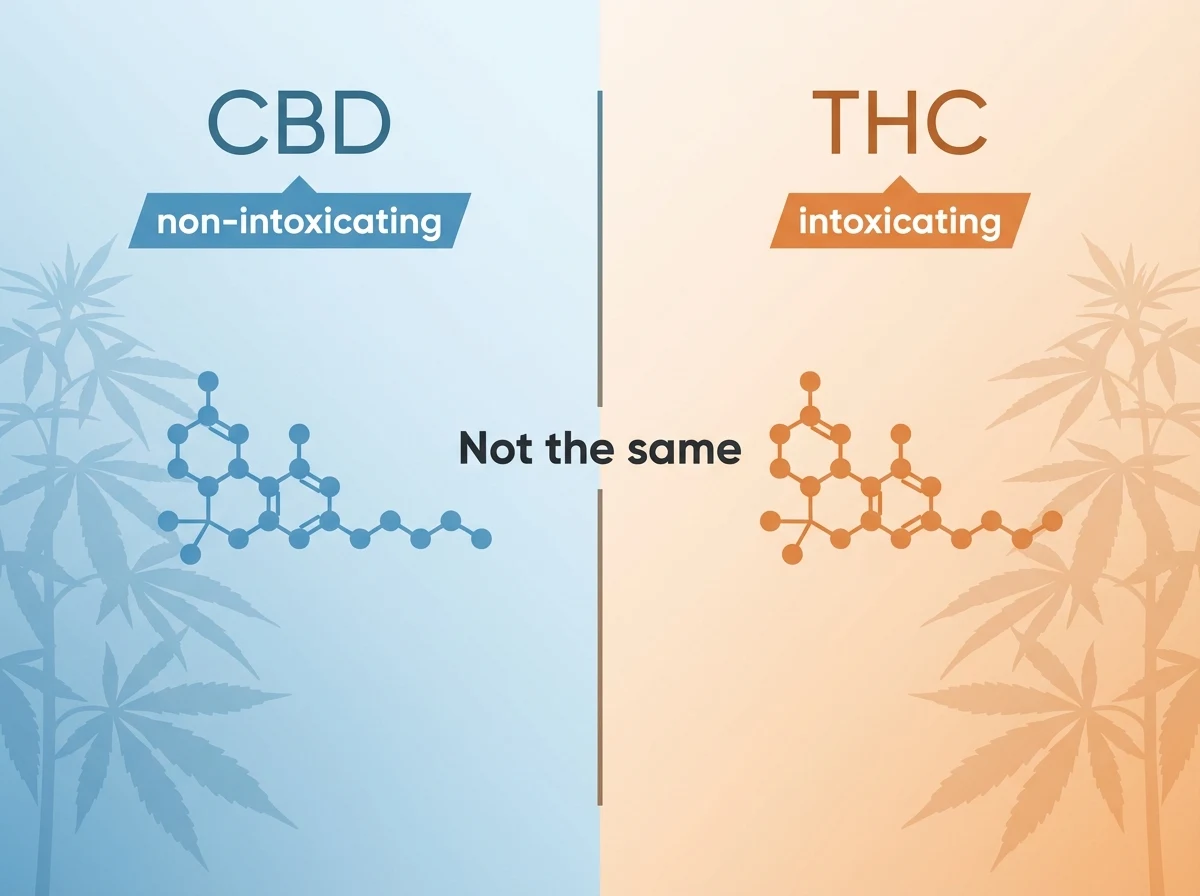
CBD is short for cannabidiol. It is a non-intoxicating compound (a cannabinoid) found in the hemp plant. Non-intoxicating matters because CBD is not the same thing as THC, the compound in cannabis that causes a “high”.
What many people overlook is that “CBD” on a label can mean very different things depending on how it is made. Some products contain CBD on its own (often called isolate). Others contain CBD alongside lots of natural plant compounds like minor cannabinoids and terpenes (often called full spectrum).
CBD is sold as a wellness supplement in the UK, not as a medicine. That means you will see lots of broad wellbeing language. If you see a company claiming CBD “treats” or “cures” specific medical conditions, that is a red flag.
CBD oil, hemp oil, cannabis oil: why the names confuse people
People often buy “hemp oil” thinking it is CBD oil. Hemp seed oil is a nutritious carrier oil (like olive oil), but it does not naturally contain meaningful CBD unless it has been infused with a hemp extract.
If you want a deeper comparison, our separate guide on premium CBD oil breaks down what “CBD oil” typically means in everyday UK shopping terms.
How CBD works: the simple version
Think of your body as running lots of balancing systems at once: sleep-wake rhythm, stress response, inflammation signalling, appetite cues, and so on. One of the systems involved in “keeping things steady” is called the endocannabinoid system (ECS).
Now, when it comes to CBD, the honest answer is that we are still learning exactly how it influences the ECS and other pathways. CBD does not “plug into” the body in one simple way. Instead, it seems to influence multiple receptors and enzymes, which may help support overall balance for some people.
Why different people feel different results
In practice, this means two friends can take the same CBD product and describe completely different experiences. Your baseline stress levels, sleep habits, diet, body size, and even how consistently you take it can all affect what you notice.
It also depends on the product format. A CBD oil taken under the tongue often feels different to a drink, a topical cream, or a patch, mainly because absorption routes vary.
CBD product types: oils, drinks, vapes, gummies and more
If you have ever typed “cbd oil uk” into Google, you will know the options can feel endless. Consider this: most CBD products fall into a few main formats, each with its own pros, cons, and best use case.
CBD oils (tinctures)
CBD oil usually means a hemp extract blended into a carrier oil. You place drops under your tongue, hold for a short time, then swallow. This route is popular because it is simple, portable, and gives you fine control over your dose.
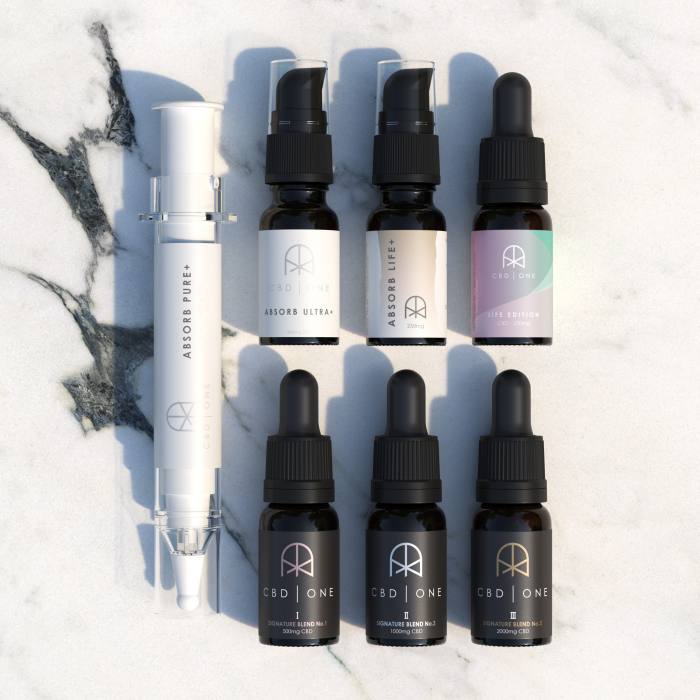
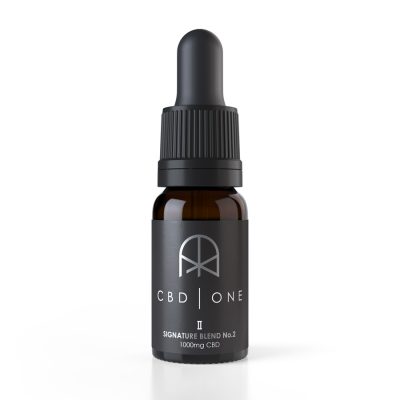
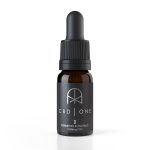
One example of an oil format is CBD One’s 10% CBD Oil [1000mg CBD], a full spectrum oil blended with hempseed oil. Oils like this tend to have a natural, earthy taste because you are getting more of the plant compounds, not just a single molecule.
Water soluble CBD (CBD drinks and “shots”)
Water and oil do not naturally mix, so “water soluble” CBD uses emulsification to help CBD disperse in liquids. From a practical standpoint, this can suit people who dislike the taste of oils or prefer adding CBD to a morning drink.
If you want to browse formats, you can compare options on the Water Soluble CBD category page.
CBD vapes
Vaping CBD refers to inhaling vapour from a CBD e-liquid or disposable vape. Absorption through the lungs can be faster than swallowing CBD, but vaping is not for everyone, and it comes with its own considerations around lung health and product quality.
The reality is that “trip cbd” style search terms often come from people worrying about intoxication. CBD itself is not intoxicating, but you should still be careful about what is in the product, especially if it is full spectrum and contains trace THC within legal limits.
CBD gummies
“CBD gummies” and “cbd gummies uk” are searched a lot because they are convenient and taste good. The catch is that gummies are swallowed, so onset can be slower and the amount you absorb can vary. In the UK, gummies also raise extra quality and compliance questions because some brands cut corners on testing and labelling.
It is also worth saying out loud that not every brand offers gummies. Some companies choose formats that they feel are easier to quality-control and dose consistently.
CBD topicals and patches
Topical CBD (creams, balms) is applied to the skin and is usually used as part of a skincare routine. Transdermal patches are different. They are designed to release CBD slowly over time through the skin.
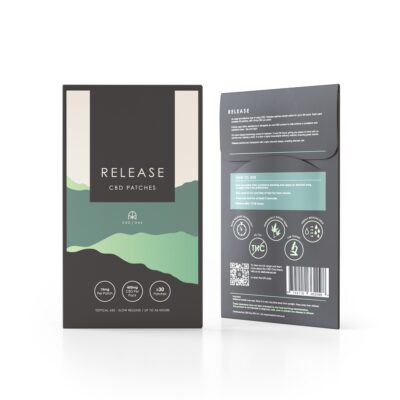
CBD One’s Release patches, for example, are isolate-based and THC-free, with the CBD Patches [30 x 15mg] | Release listing “40%+” bioavailability. That does not mean “better for everyone”, but it is a useful illustration of how delivery method can change what your body absorbs.
Full spectrum vs isolate: what those words really mean
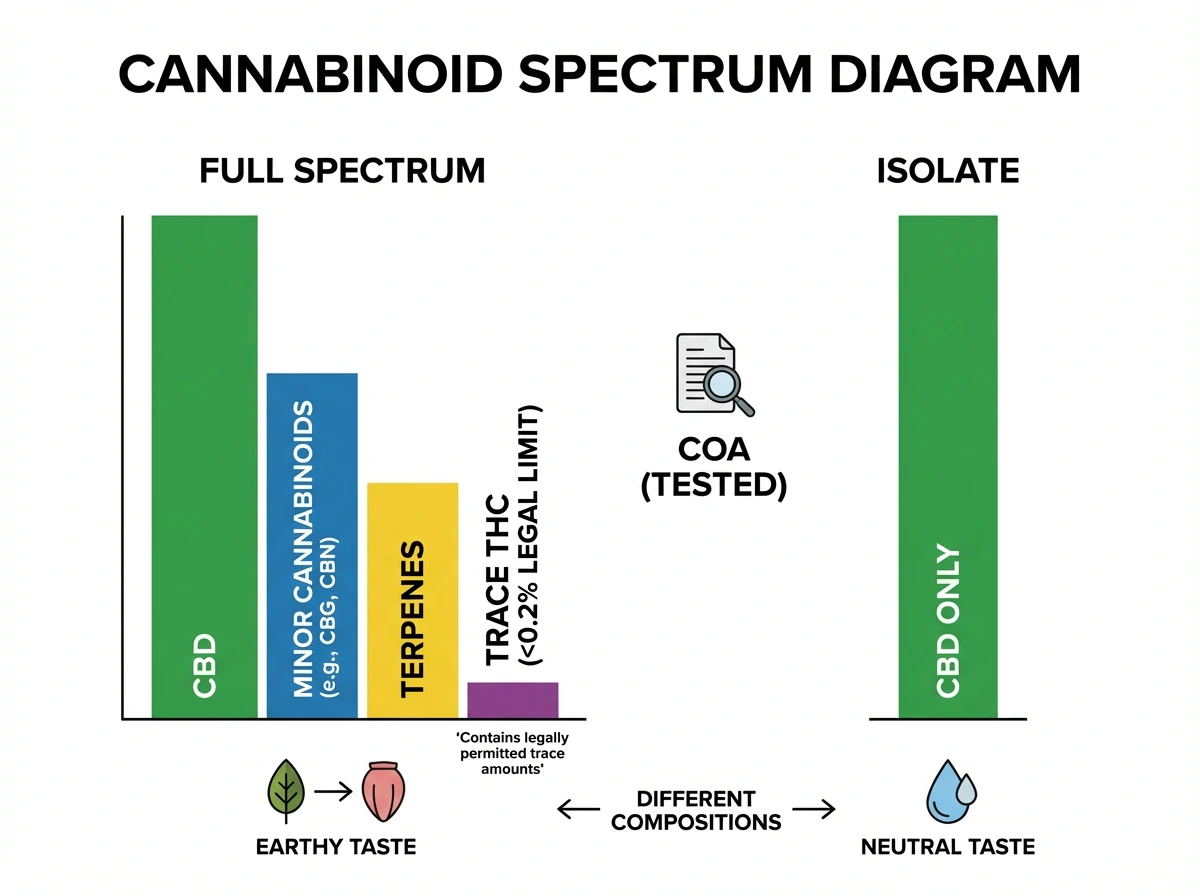
This is one of the biggest areas of confusion, and it matters because it affects taste, user experience, and even how confidently you can interpret a label.
Full spectrum CBD
Full spectrum means the extract contains CBD plus other naturally occurring hemp compounds, such as minor cannabinoids and terpenes, with trace amounts of THC within legal limits. Many people like full spectrum products because of the “Entourage Effect” idea: that plant compounds may work better together than in isolation.
At CBD One, we focus heavily on full spectrum extracts across core formats because we like the “whole plant” philosophy, and because customers often prefer that broader profile once they find their rhythm.
CBD isolate
Isolate is CBD on its own, with other cannabinoids removed. Some people choose isolate to avoid trace THC entirely, for example if they are regularly drug-tested at work or in sport. It can also have less of the “hemp” taste, depending on how it is formulated.
Neither is automatically “better”. The right choice is the one that fits your lifestyle, your sensitivities, and your need for reassurance around THC.
CBD in the UK: legality, Novel Foods, and quality basics
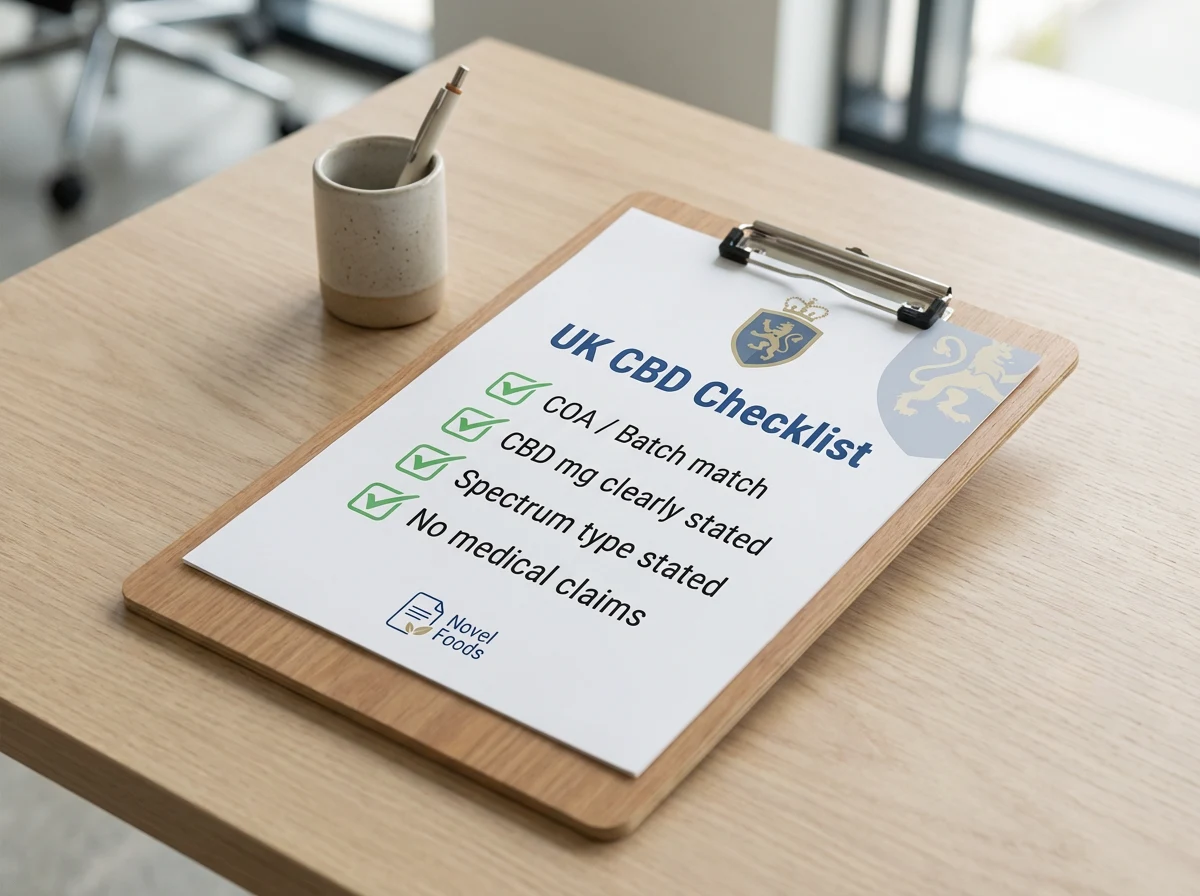
CBD is legal to buy and sell in the UK when it meets the relevant rules, including THC limits and product compliance. The details can get technical, but as a consumer you mainly want to know what “good practice” looks like when you are browsing.
CBD is not a medicine in the UK
Companies are not allowed to market CBD as if it treats, prevents, or cures disease. If a brand is making strong medical promises, be cautious. Wellness support language is normal. Medical claims are not.
Novel Food and why it matters
Many ingestible CBD products fall under the UK’s Novel Food framework. That does not automatically mean a product is “good” or “bad”, but it is part of the compliance picture and a reminder to buy from brands that take testing and paperwork seriously.
Simple quality checks you can do in 60 seconds
- Third-party lab testing: look for a Certificate of Analysis (COA) that matches the batch.
- Clear CBD content in mg: not just vague “hemp extract” language.
- Transparent spectrum type: full spectrum, broad spectrum, or isolate.
- Realistic, responsible wording: no miracle claims.
If you want to keep exploring oils from a category level, start with CBD Oils and compare strengths and serving sizes calmly, without rushing.
CBD dosage basics: start low, go slow, stay consistent
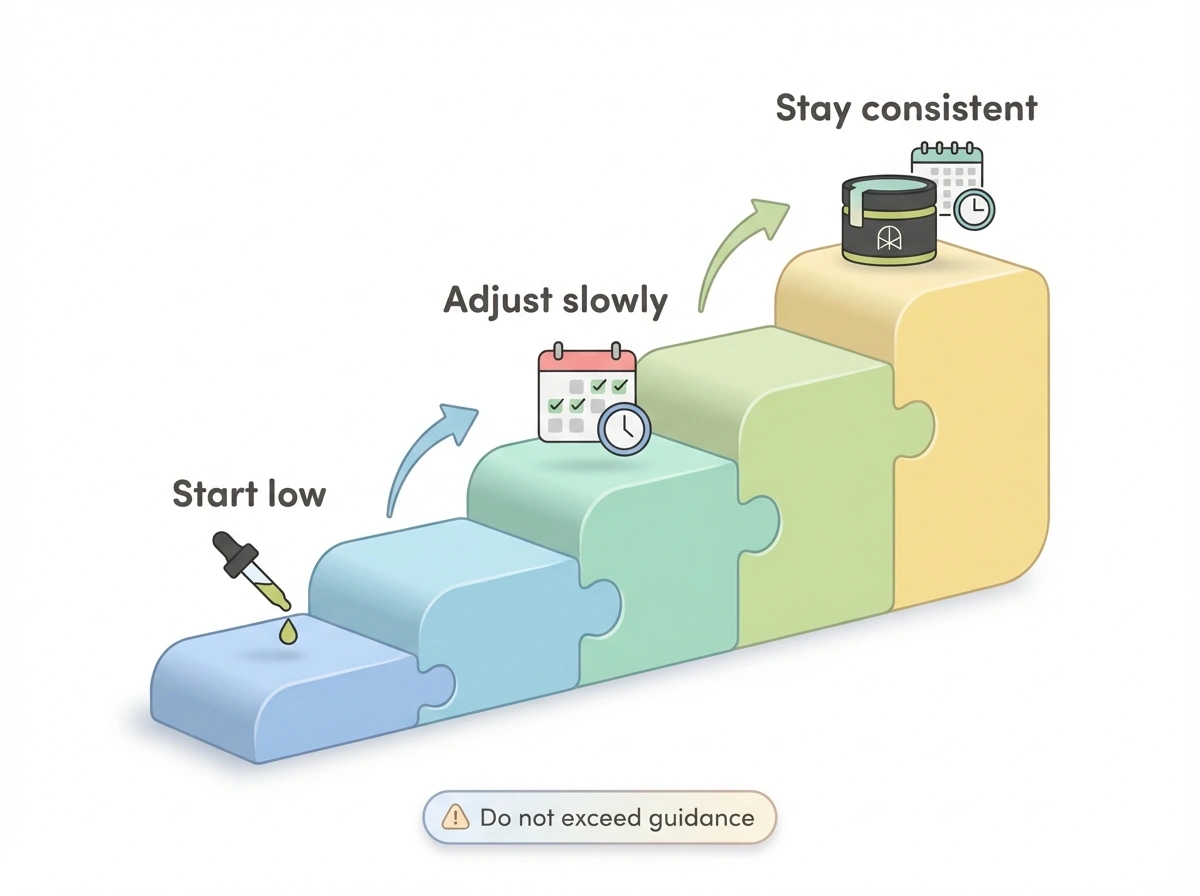
Most people do not fail with CBD because they chose the “wrong” product. They struggle because they take too much too soon, or they change things every day and cannot tell what is working.
The UK Food Standards Agency (FSA) advises healthy adults not to exceed 70mg of CBD per day. That is a sensible safety ceiling, not a target to aim for.
A practical way to approach dosing
Think of CBD like adjusting the volume on a radio. You do not jump from silent to full blast. You turn it up a little, then listen. In practice, this means starting with a small amount for several days, noticing how you feel, then adjusting gradually.
If you want help doing the maths, our CBD dosage guide can help you estimate a sensible starting point based on common product strengths.
Daily ritual beats occasional big doses
Many people report the best experience when CBD is part of a routine: same time, similar dose, and tied to a habit you already have (morning tea, after-work wind-down, bedtime skincare). Consistency makes it easier to understand your own response.
How to choose a CBD product (without falling for hype)
Search results can be messy. You will see phrases like “supreme cbd”, aggressive discounts, and products that look identical but claim totally different strengths. Consider this: your goal is not to find the most exciting label, it is to find the most trustworthy information.
Match the format to your lifestyle first
If you are already good at taking supplements, oil drops may feel natural. If you cannot stand the taste, a water soluble option that mixes into a drink may be easier to stick to. If you want a “set and forget” style routine, patches might appeal.
Then check transparency and testing
Look for lab verification, clear ingredients, and dosing instructions you can actually follow. A product should tell you exactly how many mg of CBD you are taking per serving.
Use buying guides to compare calmly
If you are at the stage of comparing brands and formats, two resources worth reading are the CBD Buying Guide and our CBD Product Comparison. They are designed to help you slow down, read labels properly, and choose with confidence.
One note on our own approach: CBD One is a family-founded UK brand, and we keep our range focused on formats we can test and dose consistently, like full spectrum oils and water soluble products. That is not the only way to do CBD, but it is the way we stay accountable.
CBD side effects and who should be cautious
Most of the time, the biggest “side effect” people experience with CBD is simply taking too much too soon, then feeling a bit off for a few hours and deciding CBD is not for them. That is why the slow and steady approach matters.
That said, CBD is still an active compound, and some people do report unwanted effects. The most commonly reported ones tend to be things like feeling sleepy, a dry mouth, light-headedness, digestive upset, or a change in appetite. These are not guaranteed, but they are worth knowing about so you can recognise what is going on.
When it is sensible to pause and get advice
If you are pregnant or breastfeeding, it is usually best to avoid CBD unless a qualified clinician has specifically advised you otherwise. The same goes if you have a long-term health condition, or you are taking prescription medication. CBD may affect how your body processes certain drugs, which is why a pharmacist or GP is the right person to check your specific situation.
Here’s the thing. People often ask whether CBD is “good for you” in a general sense. A more useful question is: does this product, at this amount, in this routine, fit your body and your lifestyle? If you feel worse, not better, that is useful information. Lower the amount, simplify the routine, or stop.
CBD and drug testing: will it show up?
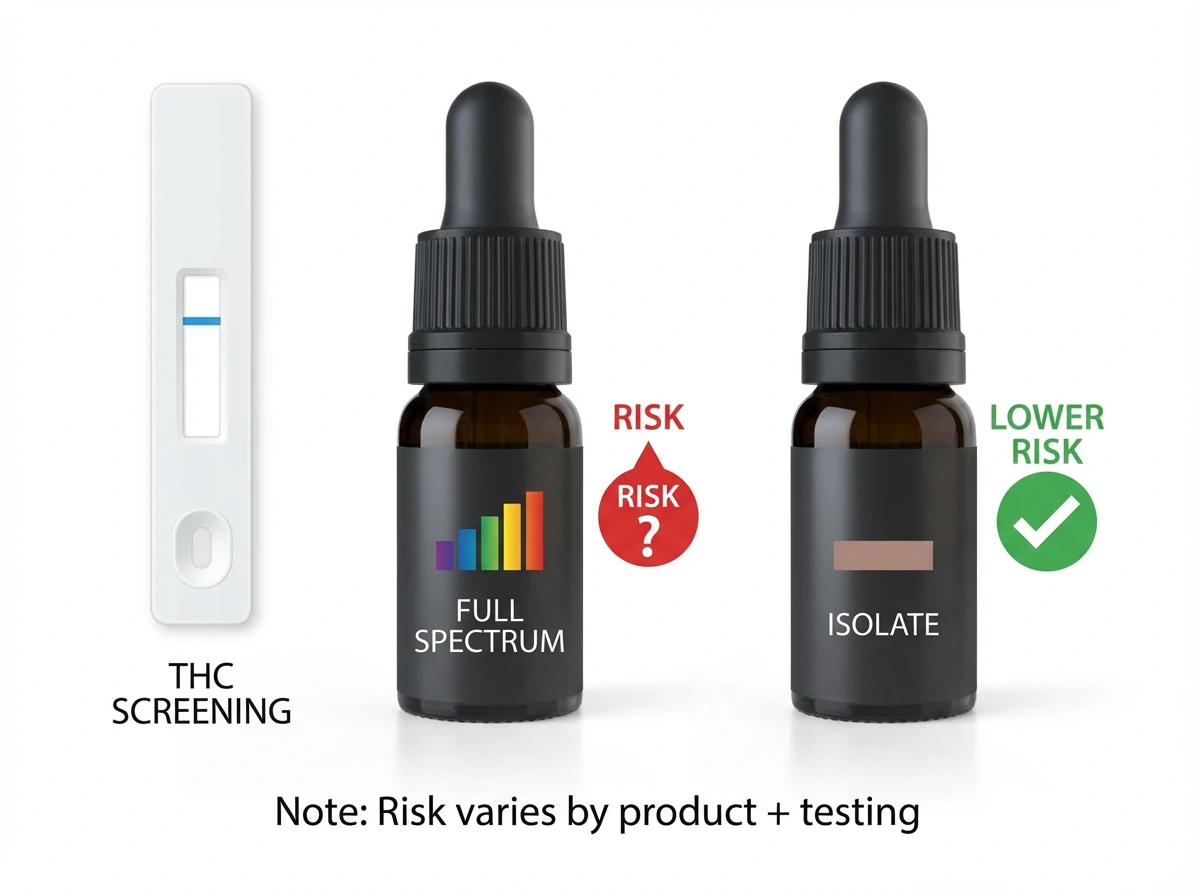
This is a really common worry, and it is one of the reasons the full spectrum vs isolate choice matters in real life.
Standard workplace drug tests usually look for THC (or THC metabolites), not CBD. In theory, pure CBD isolate should not trigger a THC result. In practice, life gets messy because not every product is what it claims to be, and even legal full spectrum products can contain trace THC within legal limits.
What many people overlook is that repeated use of a full spectrum product, even at modest amounts, could potentially lead to small amounts of THC building up in the body. This is not something you can “feel” happening, and it is not a reason to panic, but it is a reason to be cautious if testing is part of your job or sport.
A practical way to reduce risk
If you are routinely drug-tested and you cannot afford any uncertainty, isolate-based products are typically the calmer choice, and you should still prioritise third-party testing and clear batch reports. If you are unsure, speak to your employer or testing provider about exactly what is being screened.
How to read a CBD label without confusion
CBD labels can look simple until you try to compare two products. One says “10%”, another says “1000mg”, another says “high strength”, and suddenly you are not sure what you are actually taking.
mg vs %: they are describing the same idea in different ways
“mg” tells you the total amount of CBD in the bottle or pack. “%” is a concentration. A higher percentage means more CBD relative to the total volume, but you still need the mg number to understand the total amount in the product.
The more important number for day-to-day use is usually “mg per serving”. For oils, that might be mg per drop or per full dropper. For patches or gummies, it is often mg per patch or mg per gummy. This is the number that helps you stay consistent and stay within the FSA’s 70mg per day guidance.
What “hemp extract” actually means
Some labels lean heavily on words like “hemp extract” or “cannabis extract” without being clear about CBD content. From a practical standpoint, you want clarity. If you cannot quickly find the CBD amount in mg, the spectrum type, and a lab report that matches the batch, you are being asked to buy on trust alone.
Storage, shelf life, and travelling with CBD
If CBD is going to be part of your routine, it helps to treat it like any other supplement and store it properly. Oils and liquids can degrade over time, especially with heat and light. The simple rule is: keep it cool, keep it out of direct sunlight, and put the lid back on properly every time.
Does CBD go off?
CBD products tend to have a shelf life, and it is worth checking the packaging for a best-before date. An oil that has oxidised can smell or taste noticeably different. That does not automatically mean it is “dangerous”, but it can be a sign the product is past its best.
Travelling with CBD in and out of the UK
Within the UK, carrying CBD is usually straightforward if the product is compliant and clearly labelled. Travelling abroad is where people get caught out. Laws and enforcement can vary a lot between countries, even within Europe.
If you are flying, it is sensible to keep products in original packaging, carry a small amount for personal use, and check the rules of your destination country before you travel. If a place has strict cannabis laws, it may not distinguish clearly between CBD and THC products in practice.
Frequently Asked Questions
What is CBD in simple terms?
CBD (cannabidiol) is a non-intoxicating compound from the hemp plant. People use it as a wellness supplement, often as part of a daily routine like morning drops or an evening wind-down. CBD is not the same as THC, and it does not produce a “high” in the way cannabis is known for. The key is quality and clarity: you want to know how much CBD you are taking (in mg), what type it is (full spectrum or isolate), and whether the product is third-party tested.
Will CBD get you high or cause a “trip”?
CBD itself is non-intoxicating, so it should not make you feel high. The confusion often comes from THC, another cannabinoid that can be intoxicating. Some full spectrum CBD products contain trace THC within legal limits, which is not intended to intoxicate, but it can still worry people who are sensitive or cautious. If you want a straightforward explanation, read Does CBD Oil Get You High?. If you need to avoid THC completely, you may prefer an isolate-based product.
Is CBD legal in the UK?
CBD products can be legal in the UK when they meet the rules around THC limits, labelling, and compliance frameworks such as Novel Foods for ingestible products. As a buyer, your job is not to memorise every regulation, it is to shop sensibly. Look for third-party lab reports, clear cannabinoid content in mg, and responsible marketing that avoids medical claims. If a product looks like it is making unrealistic promises or hiding key information, that is usually enough to move on.
What is the difference between CBD oil and water soluble CBD?
CBD oil is a hemp extract blended into a carrier oil and usually taken under the tongue. Water soluble CBD is formulated so it disperses in liquids, which makes it easier to add to tea, coffee or a smoothie. The main difference you will notice is convenience and feel, plus potentially how efficiently your body absorbs it, depending on the formulation. Some people prefer oils for simplicity and control, others prefer water soluble products because they dislike the taste of hemp. There is no universal “best”, just what you will actually use consistently.
Are CBD gummies a good idea in the UK?
CBD gummies are popular because they are easy and taste familiar. The trade-off is that gummies are swallowed, so effects may be slower and more variable than sublingual drops. Quality also varies a lot in the UK market, especially with low-cost products sold through non-specialist retailers. If you use gummies, prioritise brands that clearly state mg per gummy, provide up-to-date lab reports, and avoid exaggerated claims. If you want tighter dose control, oils or measured pumps can feel more predictable.
How much CBD should I take?
There is no single dose that fits everyone. A sensible approach is “start low, go slow”, then adjust gradually based on how you feel and what you are using CBD for. The FSA advises healthy adults not to exceed 70mg of CBD per day. That is a safety guideline, not a target. If you want help estimating a starting point, use our CBD dosage guide. If you take any medication, it is worth speaking to a pharmacist or GP before you start.
Can I take CBD with medication?
CBD can interact with some medications, mainly because it may affect how your liver processes certain drugs. This does not mean CBD is automatically “unsafe”, but it does mean you should be cautious, especially with medicines that carry a grapefruit warning or that need tight dose control. If you are on prescription medication, the safest next step is to speak to your GP or pharmacist before using CBD. We have a dedicated article on CBD and Medication to help you prepare for that conversation.
How long does CBD take to work?
It depends on the product format and your body. Oils held under the tongue may be noticed sooner than swallowed products like gummies, because some absorption can happen through the tissues in your mouth. Drinks can vary depending on formulation, and patches are designed for slow release over many hours. What many people overlook is that consistency matters. Some users report they notice more from CBD after using it daily for a while, rather than taking one large dose once. If you are experimenting, change one variable at a time.
What should I look for when buying CBD oil in the UK?
Prioritise transparency over marketing. You want a product that clearly states total CBD in mg (and ideally per drop), lists ingredients, and provides third-party lab results for the batch you are buying. Check whether it is full spectrum or isolate, and make sure the brand avoids medical claims. If you are comparing options, use a structured resource like our CBD Buying Guide and refer back to a side-by-side CBD Product Comparison so you do not get swayed by hype.
Is it better to choose full spectrum CBD?
Full spectrum CBD contains CBD plus other hemp compounds like minor cannabinoids and terpenes, with trace THC within legal limits. Some people prefer it because of the Entourage Effect concept, where plant compounds may work together. Others prefer isolate because it is THC-free. Your best choice depends on your goals and your comfort level with trace THC. If you are drug tested, isolate may feel safer. If you want a more “whole plant” profile and you tolerate hemp well, full spectrum can be appealing.
Is CBD a drug?
In everyday UK conversation, people use the word “drug” in two different ways. Sometimes they mean “an illegal substance that intoxicates you”, and sometimes they mean “a compound that has an effect in the body”. CBD does not intoxicate you, and compliant CBD products are sold as wellness supplements in the UK, not as prescription medicines.
The important bit is how it is marketed and what is in it. If a company talks like it is selling a medicine, or it is vague about testing and THC, that is where you should be cautious.
What happens if you take CBD for the first time?
Many people feel nothing dramatic the first time, and that is normal. Others report subtle changes, like feeling a bit more relaxed, a little sleepier, or simply noticing their body feels calmer in the background. It can also be the other way round. If you take too much, you might feel heavy, drowsy, or slightly light-headed.
If you are trying CBD for the first time, start with a small amount, do it at a time when you do not need to drive or make big decisions, and give yourself a few days of consistency before you judge it.
Can you take CBD every day?
Many people choose to use CBD daily because routine makes it easier to understand what it is doing for them. The key is to keep the amount sensible, listen to your body, and stay within the UK FSA guidance for healthy adults of no more than 70mg per day.
If you are increasing your amount, do it gradually. If you are taking medication, or you have a health condition, check in with a pharmacist or GP first.
Does CBD show up on a drug test?
Drug tests are usually looking for THC, not CBD. CBD itself is unlikely to be the target, but full spectrum products can contain trace THC within legal limits, and poor-quality products can be contaminated or mislabelled.
If drug testing is part of your life, choose products with clear batch testing, and consider isolate-based options if you want to reduce uncertainty as much as possible.
Key Takeaways
- CBD is non-intoxicating, and it is not the same as THC, but product quality and lab testing really matter.
- Your experience can vary by person and by format (oil, water soluble, vape, gummies, topical, patches).
- The FSA advises healthy adults not to exceed 70mg CBD per day. Start low, go slow, and stay consistent.
- Choose transparent brands with third-party lab reports and clear mg dosing, and avoid medical claims.
- If you take medication or have health conditions, speak to a GP or pharmacist before using CBD.
Conclusion
CBD can be a helpful addition to a modern wellness routine, but it works best when you keep it simple. Start with the basics: know what CBD is, choose a format you will actually use, and buy from brands that test properly and communicate clearly. If you are tempted by trendy search terms, flashy “supreme” branding, or bargain gummies, pause and come back to the fundamentals of dosing and quality.
From a practical standpoint, oils and water soluble CBD tend to be the easiest places to begin because they give you measured control and a repeatable daily habit. If you want to go deeper on choosing, read the buying and comparison guides, and if you need help getting your dose right, use the calculator resource.
If you are unsure where to start, you can explore and learn more, or speak to Nick for free, sensible guidance.